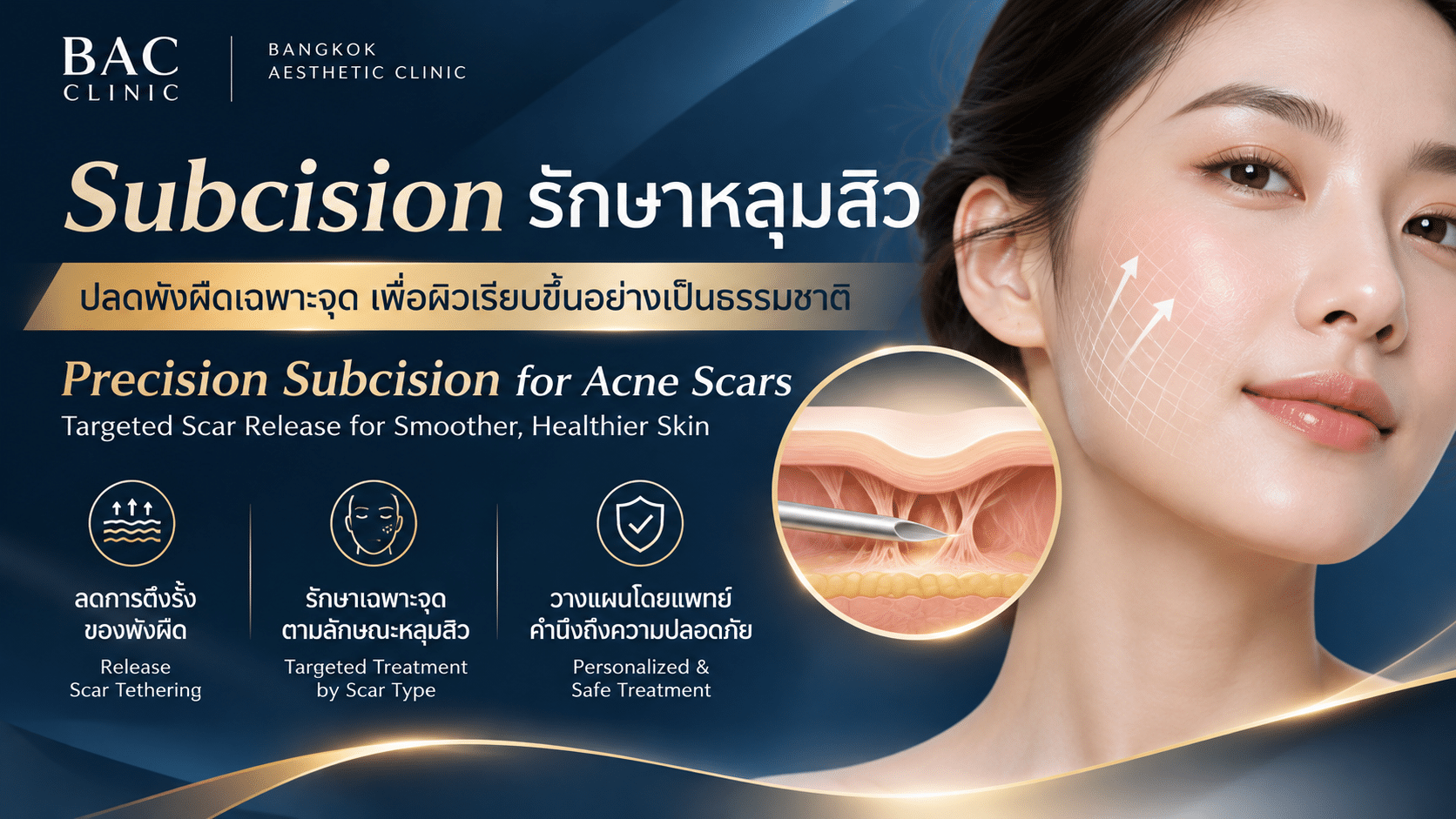
Many patients believe that the larger the area treated with subcision, the better the outcome. Some therefore expect a Full Face Subcision program to involve passing a needle beneath every part of the face, including the forehead, temples, cheeks and even areas without acne scars.
However, subcision is not a procedure in which more extensive tissue dissection automatically produces better results. Its medical purpose is to release fibrous attachments that contribute to depressed acne scars, with appropriate precision.
Performing subcision where there is no clear indication may offer little additional benefit while increasing the possibility of injury to blood vessels, nerves and normal subcutaneous structures.
1. What Is Subcision and How Does It Improve Acne Scars?
Subcision is a minimally invasive procedure used to treat selected depressed acne scars associated with fibrous tethering beneath the skin. A doctor uses a suitable instrument, such as a blunt cannula or specialized needle, to release the attachments that pull the scar downward.
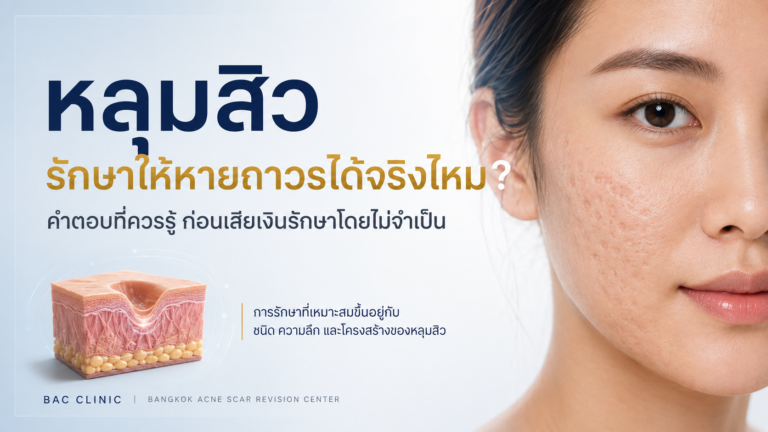
Rolling scars are commonly associated with this type of tethering. They often appear as broad, gently sloping depressions that create an uneven or wave-like skin surface.
When the responsible fibrous bands are released, the downward pulling force may decrease. This can allow the depressed skin to elevate and may stimulate tissue repair and remodeling.
Nevertheless, subcision is not appropriate for every acne scar. The scar type must be assessed before selecting a procedure.
Three Scar Shapes: Why One Treatment Does Not Fit All
Rolling scars may have tethering; boxcar and ice-pick scars need individual assessment.
Educational schematic—not a patient result
Rolling Scars
Often respond well when fibrous tethering is present. Subcision directly addresses the pulling force beneath the depression.
Boxcar Scars
May benefit from subcision if tethering contributes to the depression. Some boxcar scars are better suited to RF microneedling or other resurfacing techniques.
Ice Pick Scars
These narrow, deep scars generally do not have subcision as their primary treatment. Focal techniques such as TCA CROSS may be considered.
2. Why Is Subcision More Challenging in Thin-Tissue Areas?
The skin and subcutaneous fat are not equally thick throughout the face. Some cheek areas have more soft tissue, whereas the forehead, temples and certain regions close to bone require particular anatomical caution.
Thin-tissue areas can present several important limitations.
How Scar Tethering Is Released
A simplified cross-section. Actual release depends on anatomy and technique.
Illustration of mechanism, not a promise of complete correction
Limited Space Between Tissue Layers
When the subcutaneous layer is thin, there may be less room to maneuver the instrument safely. The doctor must carefully control the treatment plane and depth.
Blood Vessel and Nerve Injury
Important vessels and nerves may lie close to the intended dissection plane. Incorrect technique can increase the risk of bleeding, bruising, hematoma and neurological complications.
Possible Skin Contour Irregularities
Excessive tissue disruption may alter the underlying tissue architecture. In some cases, irregularities, new fibrosis or persistent lumps can develop.
Risk May Outweigh Benefit
If a depression is not caused by tethering, subcision may provide little improvement even when a large area is treated.
3. Is Subcision Necessary on the Forehead and Temples?
Why Facial Anatomy Matters
Highlighted areas represent regions for careful assessment, not universal treatment zones.
Treatment decisions require examination
The Forehead
The forehead differs anatomically from the cheeks. Its tissue layers, muscles, blood vessels and nerves must be considered when planning treatment. Some forehead scars are shallow or sharply defined without significant tethering. For these scars, a collagen-stimulating procedure such as INFINI RF Microneedling may be more appropriate. If true tethering is identified, targeted subcision can still be considered using a suitable technique.
The Temples
The temples contain complex soft-tissue layers and important neurovascular structures. A hollow appearance in this region may reflect changes in fat volume or facial anatomy rather than a tethered acne scar. Subcision therefore cannot be assumed to be the correct treatment for every temple depression.
4. Can Excessive Subcision Affect Facial Supporting Structures?
Beneath the skin are not only fat and acne scar tissue but also connective-tissue structures that link and support the skin, fat compartments and deeper facial tissues.
Some of these attachments help maintain the anatomical relationship between different facial layers.
Correctly performed acne scar subcision aims to release abnormal scar-related attachments, not to divide all naturally occurring supporting structures.
If dissection is excessively broad, performed at an inappropriate depth or directed through the wrong anatomical plane, normal tissues and structures involved in soft-tissue support may be injured.
This does not mean that standard subcision routinely causes facial sagging. Current evidence is insufficient to establish appropriately performed acne scar subcision as a general cause of long-term facial laxity.
The key issue is anatomical precision: the doctor must distinguish pathological scar tethering from normal connective tissue that should not be unnecessarily disturbed.
5. Why Do Doctors Release Only Clinically Relevant Scar Attachments?
The purpose of subcision is to address the underlying cause of selected depressed scars, not to maximize the treated surface area.
Before treatment, the doctor assesses scar shape, depth, tissue thickness, anatomical location and the likelihood of fibrous tethering.
If a particular scar has no clinically significant attachment to release, subcision may add little benefit while introducing unnecessary procedural risk.
For example, a patient may have scars on both cheeks and the forehead, but significant tethering may be identified only in the cheeks.
In that situation, the doctor may perform subcision on both cheeks and recommend a different technique for the forehead.
This is not necessarily an incomplete procedure. It can represent a treatment plan matched to the characteristics of the patient’s scars.
The quality of acne scar treatment is not measured by how many times an instrument passes beneath the skin, but by clinical appropriateness, safety and the results achieved.
6. What Are the Side Effects of Subcision?
Subcision involves controlled disruption of subcutaneous tissue. Side effects can occur even when the procedure is performed by an experienced doctor.
Possible side effects include:
- Swelling and bruising.
- Tenderness or soreness in the treated area.
- Subcutaneous bleeding or hematoma.
- Temporary contour irregularities.
- New fibrosis or persistent subcutaneous nodules.
- Infection, which is less common.
- Vascular or nerve injury, which may be serious in certain anatomical locations.
7. Does Full Face Subcision Mean Treating Every Area?
Not necessarily.
In the context of the BAC Clinic Full Face Subcision program, Full Face refers to assessment and treatment of appropriate acne scar areas across the face according to medical indications and the agreed treatment plan.
It does not mean that every facial region must undergo subcutaneous dissection without exception.
The doctor selects areas where fibrous tethering is identified and where subcision is appropriate.
For example, a patient may have acne scars on both cheeks while the forehead has no tethering requiring release. The doctor may perform subcision on both cheeks without treating the forehead.
This remains consistent with a full-face assessment and a clinically selected treatment plan.
Patients should receive a clear explanation of the planned treatment areas, limitations and fees before the procedure.
8. How Much Does Subcision Cost at BAC Clinic?
BAC Clinic offers subcision as a standalone procedure, a full-face program and an add-on to selected laser or RF microneedling programs.
Understanding Per-Scar and Full-Face Pricing
One point is one individual acne scar, not an entire cheek.
Prices are shown in the table below
| Treatment Program | THB |
|---|---|
| Standalone Subcision — One Acne Scar Point | ฿900 |
| Standalone Subcision — Full Face | ฿2,900 |
| Subcision One Point with Picosecond Laser or INFINI RF | ฿500 |
| Full Face Subcision with Picosecond Laser or INFINI RF | ฿1,500 |
| PDRN + Full Face Subcision | ฿3,990 |
- One scar on the left cheek treated individually counts as one point.
- Three separate scars on the right cheek count as three points when per-point pricing applies.
- Treating both cheeks does not automatically mean the treatment consists of only two points.
9. How Can Subcision Offer the Best Value?
The value of acne scar treatment should not be judged solely by the area covered. More important is whether the selected procedure addresses the actual cause of each scar.
For tethered rolling scars, subcision can be an important treatment because it directly reduces the fibrous pulling force beneath the skin.
When different types of scars coexist, subcision alone may not be sufficient.
Subcision + INFINI RF Microneedling
Subcision focuses on releasing fibrous tethering, while INFINI RF Microneedling stimulates collagen remodeling and may improve skin texture and selected depressed scars.
Subcision + TCA CROSS
This combination may be considered when rolling scars and ice pick scars coexist. Each technique addresses different scar characteristics.
Subcision + Additional Skin-Quality Treatments
The doctor may consider supplementary procedures when appropriate to address skin quality or residual concerns not fully treated by subcision alone.
10. Frequently Asked Questions About Subcision
Under a Full Face program, the doctor assesses the face and treats suitable tethered areas. If only the cheeks require release, the procedure may be limited to those areas within the agreed plan.
Forehead scars may not be caused by fibrous tethering, or the anatomical risk may outweigh the expected benefit. Another treatment may be more suitable.
It may be considered in selected cases after evaluating tissue thickness, vessels, nerves and the need for scar release.
There is insufficient evidence that appropriately performed subcision routinely causes facial sagging. However, inappropriate tissue dissection can produce complications.
No. One point means one individual acne scar. Patients with multiple suitable scars may consider the Full Face program at 2,900 THB.
Subcision can improve selected tethered scars but cannot guarantee completely smooth skin or prevent recurrent tethering. Some patients require several sessions or combination treatment.
Further Guidance: Choosing Subcision Wisely
How is a tethered scar identified?
The clinician considers the shape of the depression, the way the skin moves and stretches, the depth of the scar, and whether a fibrous attachment appears to pull the surface down. Similar-looking depressions may have different underlying causes. This is why photographs alone cannot always establish whether subcision is needed.
Why can two scars on the same cheek require different treatments?
A broad rolling depression may benefit from release of a fibrous band, while a sharply edged boxcar scar may require collagen remodeling or another targeted technique. A narrow ice-pick scar is usually not primarily treated by wide subcision. Selecting treatment by morphology may be more useful than treating every depression identically.
What should be discussed before treatment?
Patients should understand which areas are planned for release, which scars may need other procedures, the expected recovery, possible complications, whether the program is per-scar or full-face, and the total fee. A full-face assessment should not be confused with a promise to dissect every region.
What happens during recovery?
Temporary swelling, tenderness and bruising are common. The visible skin surface may look uneven while tissue swelling resolves. Avoiding unnecessary pressure and following the treating clinician’s individualized aftercare instructions can support recovery. Worsening pain, rapidly increasing swelling, unusual skin discoloration or numbness should be evaluated promptly.
Why may multiple sessions be needed?
Scar improvement is a process rather than an instant guarantee. The degree of tethering, depth, scar age, healing response and accompanying skin texture changes affect results. Some patients need repeat treatment or combinations such as RF microneedling or focal TCA CROSS, depending on the scars.
Conclusion: Precision Matters More Than Treatment Area
Subcision requires an understanding of scar morphology, fibrous tethering and facial anatomy.
Choosing not to perform subcision in a particular region does not automatically mean the treatment is incomplete. It may reflect a clinical decision to avoid unnecessary disruption of healthy tissue.
Special attention is needed in thin-tissue areas such as the forehead and temples, where the expected benefit must be weighed against anatomical risks.
At BAC Clinic, treatment planning emphasizes medical indications, appropriate scar release and preservation of normal tissue.
The goal is not the number of needle passes. It is meaningful scar improvement with careful consideration of safety and long-term tissue integrity.
Personalized Acne Scar Consultation
BAC Clinic · Sukhumvit 16, Bangkok · Near BTS Asok and MRT Sukhumvit. A brief initial doctor consultation is complimentary by appointment.
BAC Clinic Website