
Laser Hair Removal in Bangkok for Different Skin & Hair Types
Less shaving. Less waxing. Less maintenance. BAC Clinic offers advanced laser hair reduction in Bangkok with technology selected according to skin tone, hair thickness, follicle depth, treatment area and individual treatment goals.
Quick Answer: What Laser Hair Removal Does BAC Clinic Offer in Bangkok?
BAC(Bangkok Aesthetic Clinic)provides laser hair reduction in central Bangkok starting from ฿549 per session. The clinic has access to Program Fotona XP Long Pulse Nd:YAG 1064 nm, Triple-Wavelength Diode and IPL. Instead of automatically using one device for every patient, treatment can be selected according to current skin tone, hair pigment, hair diameter, follicle depth, treatment area, recent sun exposure and previous laser history.
Laser hair reduction is normally performed as a series. This is because hair follicles do not all enter the same growth phase at the same time. Many patients begin with approximately 6–8 sessions, although the number may be higher or lower depending on the treatment area and individual response.
Quick Facts Before You Book
Starting Price
Upper Lip + Around Mouth starts from ฿549 per session.
Hair-Reduction Technologies
Fotona Long Pulse Nd:YAG, Triple-Wavelength Diode and IPL.
Typical Starting Course
The number varies by treatment area, density, thickness and response.
Long Pulse Nd:YAG
1064 nm is an important wavelength when treating deeper coarse hair or more pigmented skin.
Sukhumvit Location
BAC Clinic is located in Sukhumvit 16, central Bangkok.
Heat Avoidance
Intense exercise, sauna and excessive heat may be avoided temporarily after treatment when advised.
Shaving and Waxing Remove Hair Temporarily. Laser Targets the Growth Process.
Shaving is convenient, but it cuts hair only at the surface. For people with fast-growing hair, stubble can become noticeable again within a short period. Frequent shaving may also contribute to irritation, razor bumps or an ongoing cycle of maintenance.
Waxing generally keeps skin free from visible hair for longer than shaving, but it requires the hair to regrow before each session. It can also be uncomfortable, especially on sensitive areas such as the bikini line, underarms or face.
Laser hair removal works differently. Light energy is absorbed by pigment within suitable hairs and converted into controlled heat. The goal is to create thermal damage in follicular structures involved in hair growth. As treatment progresses, regrowth may become less dense, finer and slower.
| Method | How It Works | Regrowth | Maintenance |
|---|---|---|---|
| Shaving | Cuts visible hair at skin surface | Fast | Frequent |
| Waxing | Pulls hair shaft from the follicular canal | Slower than shaving | Repeated indefinitely |
| Laser Hair Reduction | Uses light absorbed by pigment to create controlled follicular heat | Progressive reduction | Series of sessions, then occasional maintenance if needed |
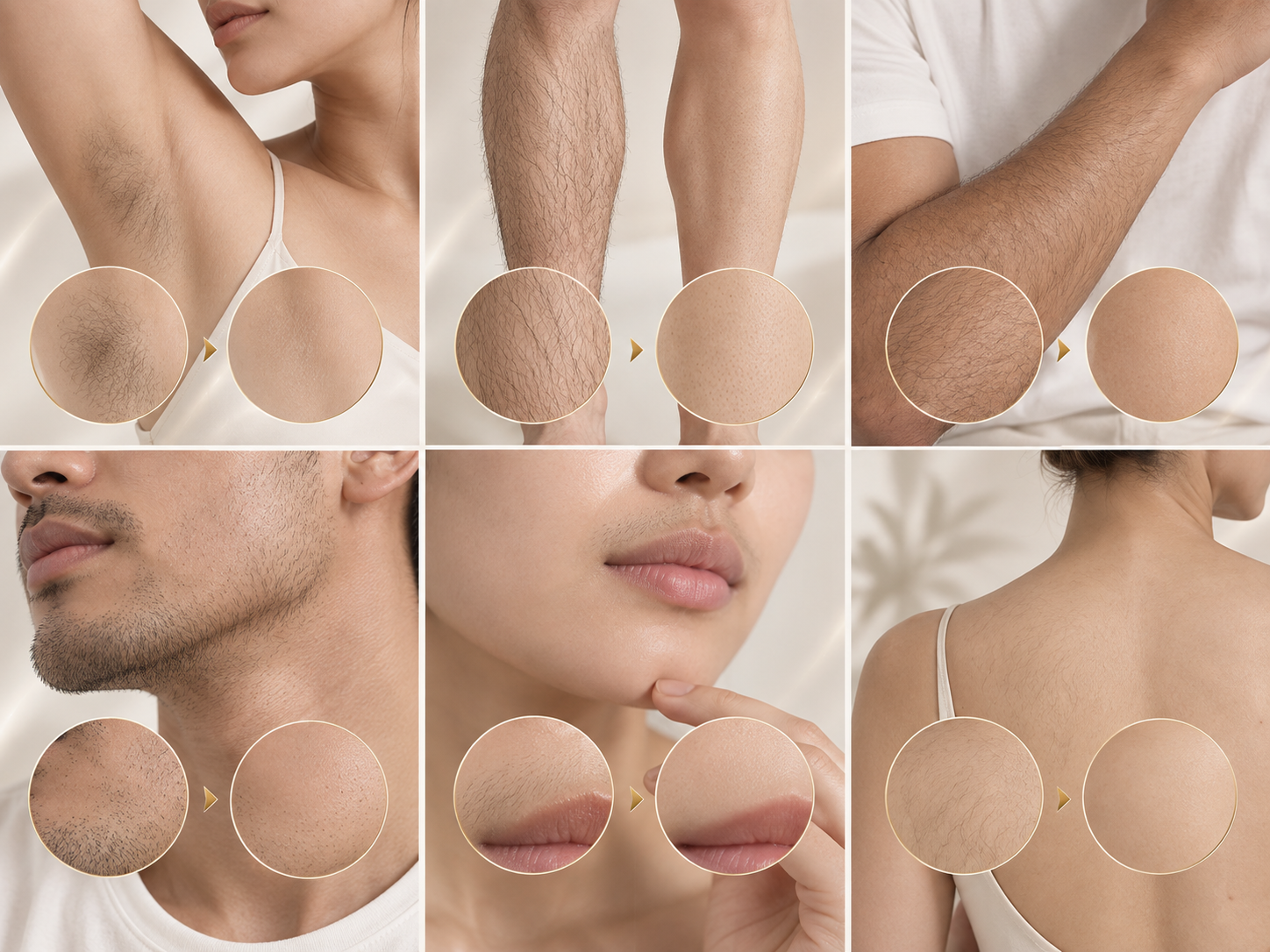
Illustration of different treatment areas, skin tones and hair patterns. Individual results vary.
Why One Laser Is Not Automatically Best for Everyone
A fine hair on the upper lip and a dense male beard hair are not the same optical target. Underarm and bikini hairs are commonly thicker and deeper than fine facial hairs.
Skin pigmentation matters as well. Melanin exists not only inside hair, but also in the epidermis. This means laser energy can be absorbed both by the target hair and by surrounding skin pigment.
For that reason, BAC Clinic does not select laser only by machine name. Treatment can be planned around:
- Current skin tone
- Hair colour
- Hair diameter
- Follicular depth
- Treatment area
- Recent tanning
- Previous laser history
How Does Laser Hair Removal Actually Work?
Laser hair-removal systems are based on the principle of selective photothermolysis. In simple terms, the device emits light at a wavelength chosen to interact with a specific target. In hair reduction, the major target is melanin within pigmented hair and follicular structures.
When sufficient laser energy is absorbed, the light converts into heat. The intention is to produce enough thermal effect to impair structures responsible for future hair growth while minimizing unnecessary thermal injury to surrounding tissue.
This is why hair colour matters. Dark brown and black hair usually contain more melanin than grey, white or very pale blond hair. Without enough pigment, conventional melanin-targeting systems have a weaker optical target.
Skin colour matters for the opposite reason: epidermal melanin can compete with hair for the incoming laser energy. As skin pigmentation increases, wavelength choice, cooling, pulse duration and conservative treatment parameters become increasingly important.
Program Fotona Nd:YAG vs Triple-Wavelength Diode vs IPL
Program Fotona XP Long Pulse Nd:YAG 1064 nm
Long Pulse Nd:YAG uses a wavelength of 1064 nm. This longer wavelength penetrates relatively deeply and interacts less strongly with epidermal melanin than several shorter hair-removal wavelengths.
These properties make Nd:YAG an important option for:
- Darker or more pigmented skin tones
- Deep, coarse terminal hair
- Male beard hair
- Underarm hair
- Bikini and Brazilian hair
- Chest and back hair
Triple-Wavelength Diode
Triple-Wavelength Diode platforms combine wavelength characteristics around 755 nm, 808 nm and 1064 nm within one hair-reduction system.
In practical treatment, Diode technology can be useful for:
- Arms and legs
- Underarms
- Bikini areas
- Large body areas
- Medium-to-coarse pigmented hair
IPL Hair Reduction
IPL is technically not a single-wavelength laser. It is a broadband light system filtered into selected wavelength ranges.
IPL may still be considered for selected skin and hair combinations, particularly when there is a favourable contrast between darker hair and lighter surrounding skin.
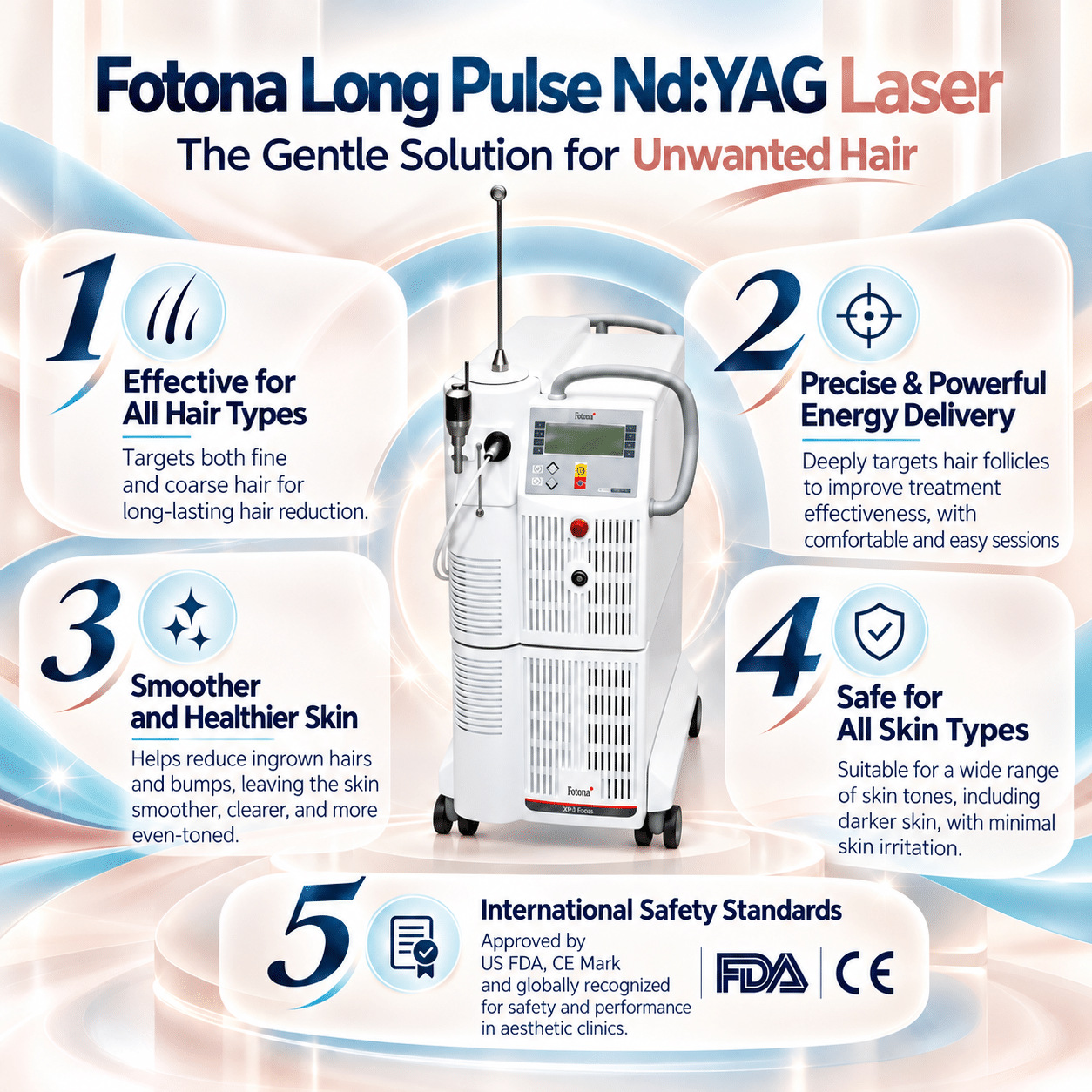
Why Program Fotona XP Is an Important Hair-Removal Option
Deep coarse hairs do not always behave like fine superficial hairs. Male beard follicles, bikini hairs and some body hairs can extend deeper into the skin.
The 1064-nm Nd:YAG wavelength provides relatively deep penetration and has lower absorption by epidermal melanin than many shorter wavelengths. That can be particularly useful in more pigmented skin.
Cooling is also important. Cooling helps protect the skin surface and may improve patient comfort during treatment.
Laser Hair Removal for Asian, Tanned and Darker Skin
One of the most important factors in laser hair reduction is the amount of pigment in both the hair and surrounding skin.
Ideally, the laser energy should be absorbed strongly by the pigmented hair target while minimizing absorption by the epidermis.
When skin contains more melanin, the safety margin can become narrower. This is why longer wavelengths, appropriate fluence, suitable pulse duration and effective cooling become particularly important.
Long Pulse Nd:YAG at 1064 nm is widely used in darker Fitzpatrick skin phototypes because the longer wavelength has relatively lower absorption by epidermal melanin.
Laser Selection by Skin and Hair Type
| Skin / Hair Situation | Technology Often Considered | Reason |
|---|---|---|
| Fair skin + dark coarse hair | Diode / Nd:YAG / selected IPL | Strong contrast between hair pigment and surrounding skin |
| Asian skin + dark hair | Diode / Nd:YAG | Selection can be adjusted according to pigment and follicular depth |
| Darker skin phototypes | Long Pulse Nd:YAG | 1064 nm has relatively lower epidermal melanin absorption |
| Recently tanned skin | Assessment before treatment | Increased epidermal pigment can alter treatment risk |
| Dense male beard | Long Pulse Nd:YAG | Beard hairs are often coarse and relatively deep |
| Underarm hair | Diode / Nd:YAG | Commonly dark and coarse |
| Bikini / Brazilian hair | Diode / Nd:YAG | Hair is usually thick and intimate skin may be more pigmented |
| Large arms / legs / body areas | Triple-Wavelength Diode or Nd:YAG | Large-area efficiency and skin type both matter |
| Grey / white hair | Limited response | Insufficient melanin for conventional hair-removal lasers |
| Very fine facial hair | Careful assessment | Fine hairs may be weak optical targets and should not be treated indiscriminately |
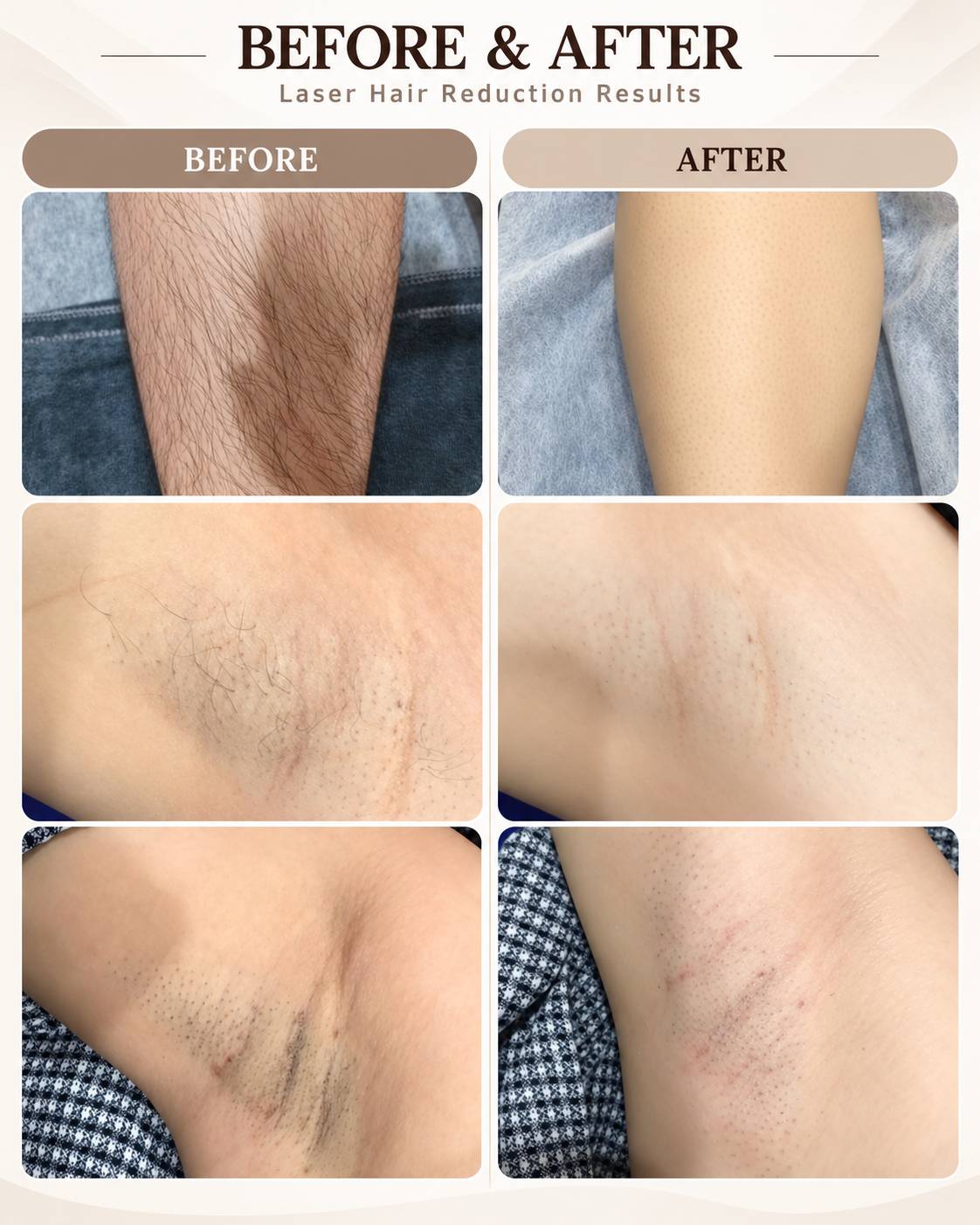
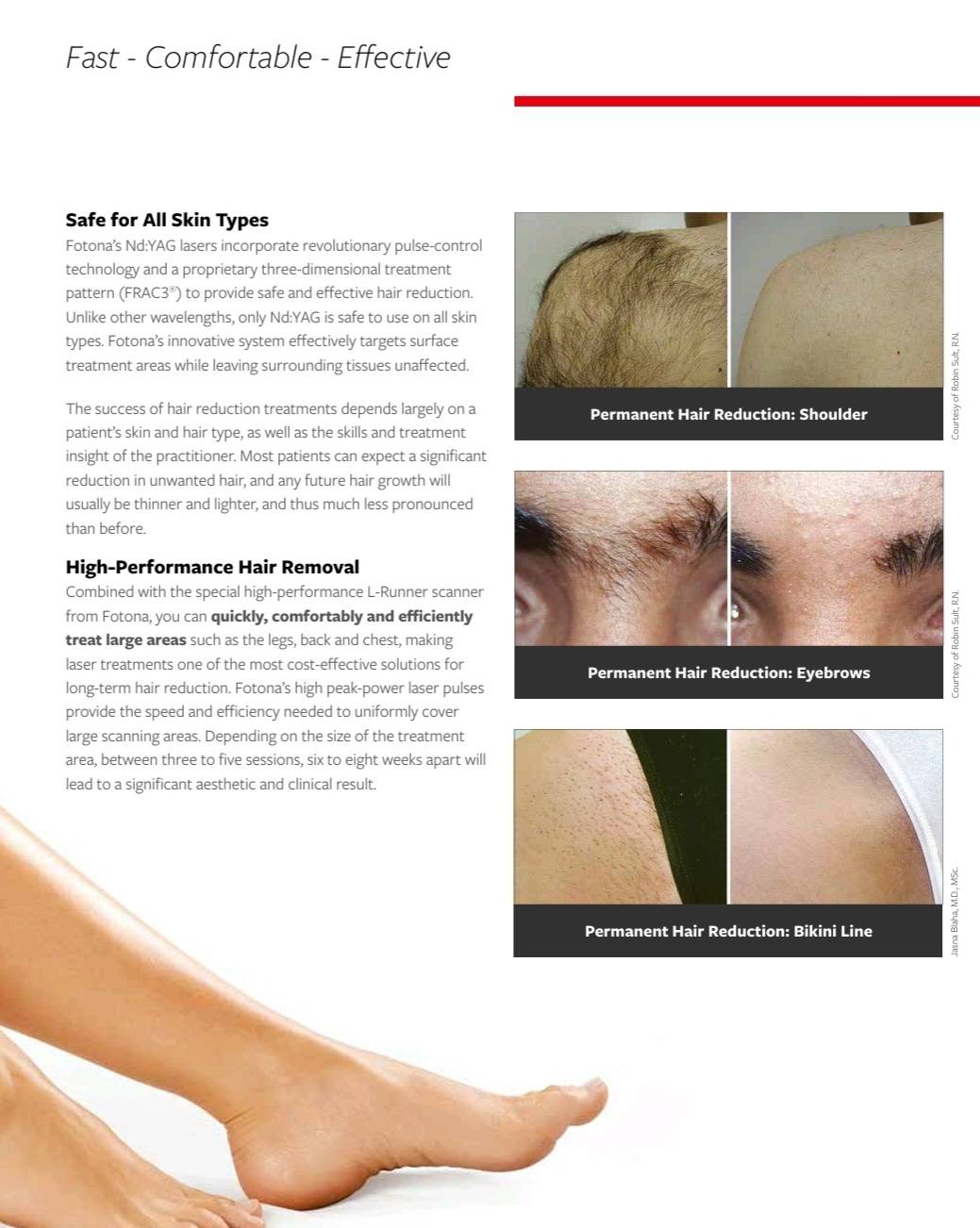
Clinical before-and-after photographs. Individual results and number of sessions vary.
Hair Removal Is a Process, Not a One-Session Promise
A responsible laser hair-removal page should not promise “100% permanent removal after one session.”
Hair follicles do not all grow simultaneously. The percentage of hairs in a favourable target phase varies by treatment area. Some hairs therefore respond during one session, while others may become treatable at later appointments.
After a successful course, patients may notice:
- Lower hair density
- Slower regrowth
- Finer hair diameter
- Less frequent shaving or waxing
- Smoother appearance in many treated areas
Laser Hair Removal for Face, Underarms, Bikini, Beard and Body
Upper Lip & Around the Mouth
Facial hair around the mouth may range from very fine hair to more visible terminal hairs. Very fine or minimally pigmented hair may respond differently from coarse dark hair.
Chin & Jawline
Chin and jawline hair can be hormonally influenced and may become coarse over time. A sudden or marked increase in facial hair may require medical assessment rather than cosmetic treatment alone.
Underarm Laser Hair Removal
Underarm hair is commonly dark, coarse and dense, which often makes it a favourable laser target.
BAC Clinic lists underarm laser hair reduction starting from ฿599.
Bikini Line & Brazilian
Bikini hair is commonly thicker and deeper than many other body hairs. Skin in intimate areas may also contain more pigmentation.
For this reason, careful wavelength and parameter selection is especially important.
Men’s Beard & Neck
Male beard follicles can be dense, coarse and deep. Treatment does not necessarily mean removing the entire beard.
Some patients use laser hair reduction for beard shaping, cleaner neck borders or reduced density.
Arms & Legs
Arms and legs cover larger surface areas and can contain a mixture of fine and coarse hairs.
Diode platforms can be useful for efficient large-area coverage.
Chest & Abdomen
Male chest and abdominal hair may be dense and relatively deep. Treatment intervals are often longer than facial areas because body hair generally cycles more slowly.
Back & Shoulders
Back and shoulder hair can be hormonally influenced and may cover a large surface area.
Long-term maintenance may occasionally be useful even after a successful initial course.
Laser Hair Removal Prices in Bangkok
BAC Clinic offers both single-session and multi-session programs. The table below follows the current BAC Clinic program card.
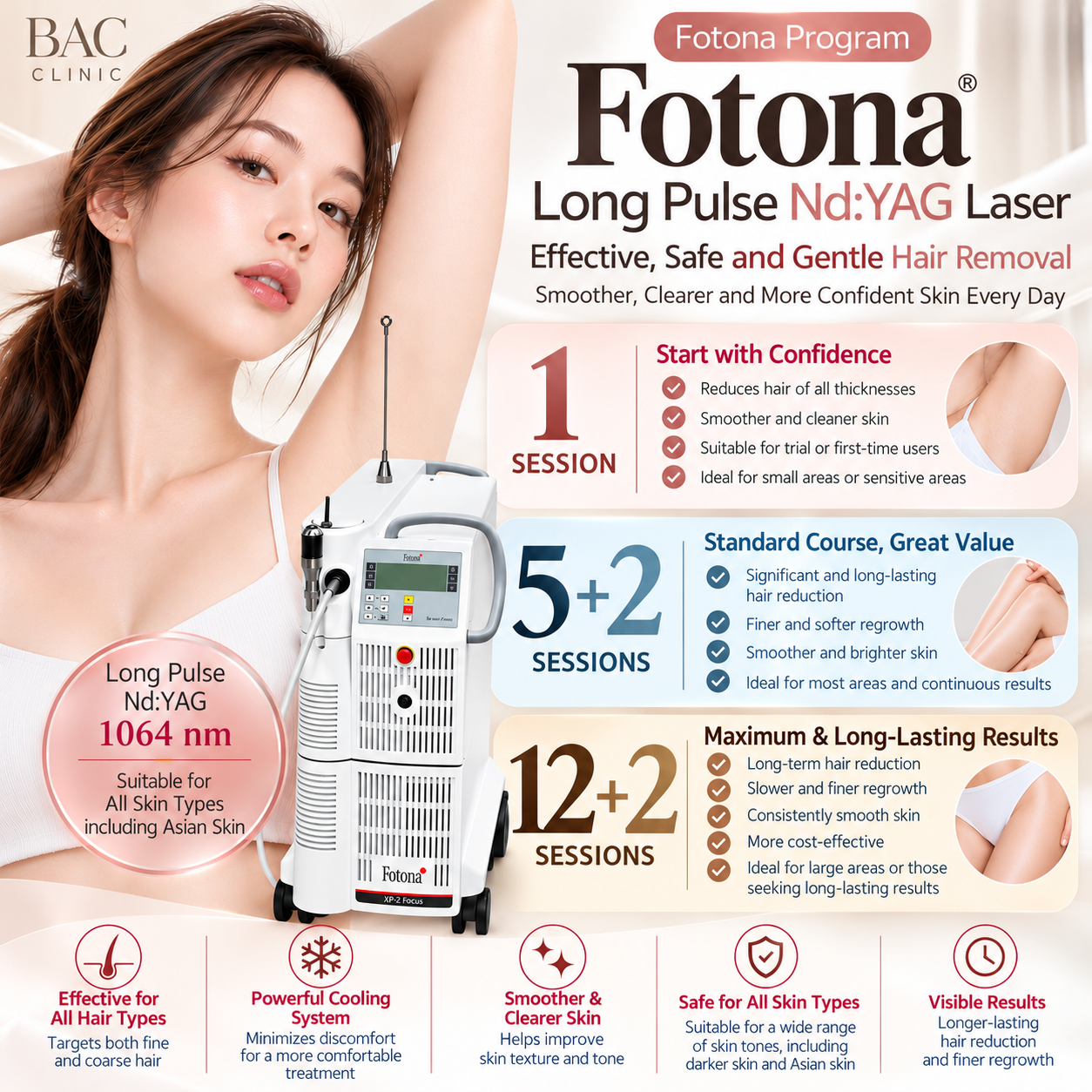
| Treatment Area | 1 Session | 3 Sessions | 5 + 2 Free | 12 + 2 Free |
|---|---|---|---|---|
| Underarms BEST SELLER | ฿599 | ฿1,590 | ฿3,090 | ฿5,590 |
| Upper Lip + Around Mouth | ฿549 | ฿1,390 | ฿2,590 | ฿4,090 |
| Bikini Line | ฿999 | ฿2,490 | ฿4,090 | ฿7,090 |
| Beard + Chin | ฿999 | ฿2,490 | ฿4,090 | ฿7,090 |
| Full Face | ฿1,790 | ฿4,590 | ฿9,090 | ฿15,090 |
| Brazilian + Anus | ฿2,090 | ฿5,490 | ฿9,590 | ฿17,090 |
| Upper Arms | ฿1,590 | ฿4,090 | ฿7,090 | ฿12,090 |
| Lower Arms | ฿1,590 | ฿4,090 | ฿7,090 | ฿12,090 |
| Abdomen | ฿2,490 | ฿6,590 | ฿11,590 | ฿20,090 |
| Chest | ฿2,490 | ฿6,590 | ฿11,590 | ฿20,090 |
| Lower Legs | ฿2,490 | ฿6,590 | ฿11,590 | ฿20,090 |
| Upper Legs | ฿3,090 | ฿8,190 | ฿14,090 | ฿24,690 |
| Back | ฿3,090 | ฿8,190 | ฿14,090 | ฿24,690 |
| Full Body | ฿15,100 | ฿39,100 | ฿69,100 | — |
Promotions and package conditions may change. Please confirm current pricing, package validity and promotional terms with BAC Clinic before treatment.
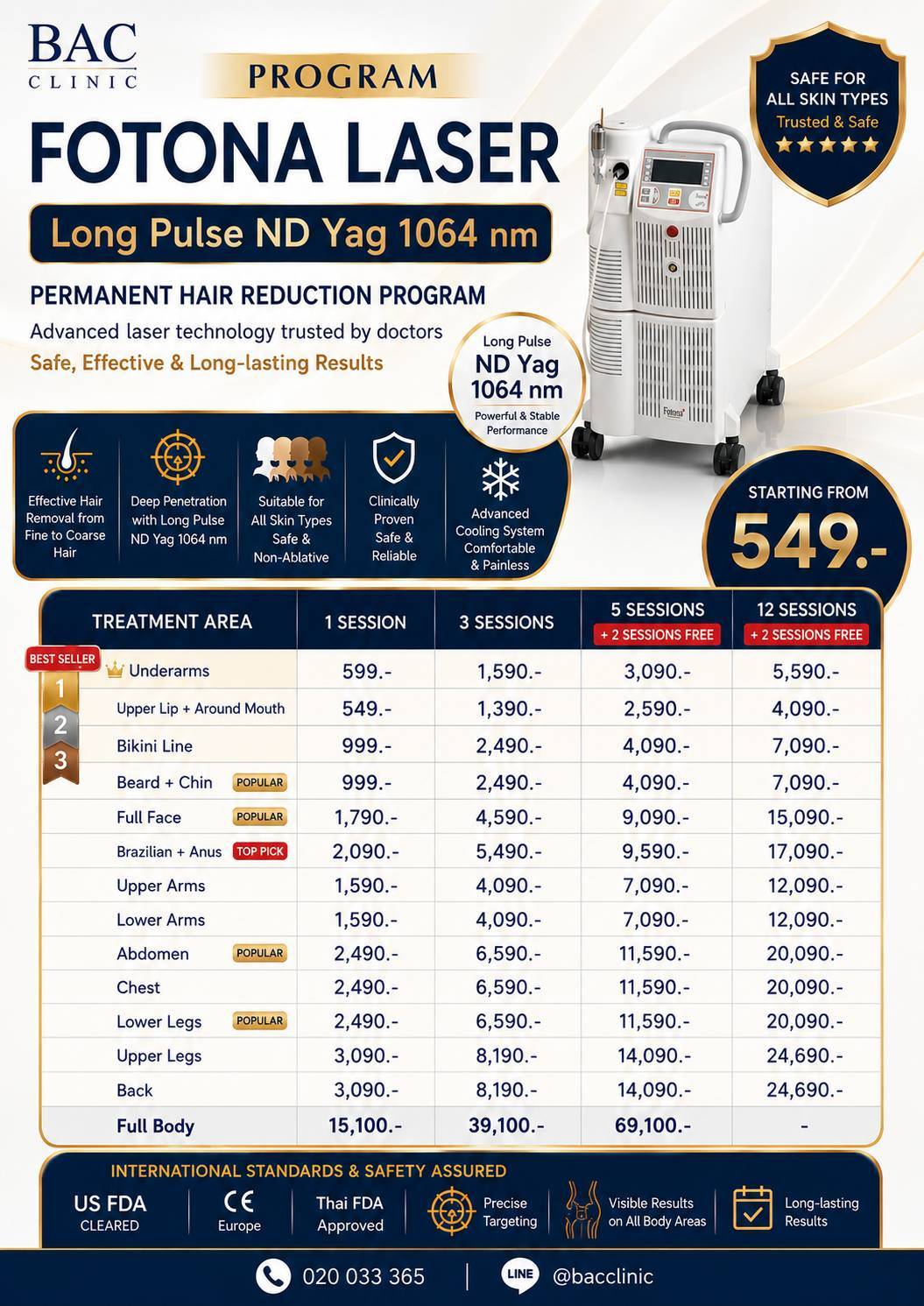

BAC Clinic laser hair-reduction program. Please confirm current promotions before booking.
How Many Laser Hair Removal Sessions Do You Need?
Hair follicles do not all enter active growth at the same time. This is one of the main reasons laser hair reduction cannot normally be completed in a single treatment.
Hair cycles through active growth, transition and resting phases. Hairs with sufficient pigment in a favourable active stage generally represent the strongest laser targets.
A practical starting framework for many patients is approximately 6–8 sessions. Some people require fewer; others require more.
The number can depend on:
- Treatment area
- Hair density
- Hair thickness
- Hair colour
- Hormonal influences
- Previous hair-removal treatment
- Individual response
Typical Starting Intervals
| Area | Typical Interval | Reason |
|---|---|---|
| Face / Upper Lip / Chin | About 4–6 weeks | Facial hair often cycles faster |
| Underarms | About 6–8 weeks | Dense terminal hair |
| Bikini / Brazilian | About 6–8 weeks | Coarse body hair with slower cycles than the face |
| Chest / Back | About 8–10 weeks | Body hair generally cycles more slowly |
| Arms / Legs | About 8–10 weeks | Longer resting phases |
As hair reduction progresses, scheduling may be adjusted according to actual regrowth rather than following a fixed calendar forever.
Read the Full Guide: How Many Laser Hair Removal Sessions Do You Need? →
Who Is a Good Candidate for Laser Hair Reduction?
Commonly Favourable Characteristics
- Black or dark brown hair
- Medium-to-coarse terminal hair
- Stable skin condition in the treatment area
- Realistic expectations
- Willingness to complete multiple sessions
- Able to avoid plucking or waxing between sessions
Situations That Need Extra Assessment
- Grey or white hair
- Very pale blond hair
- Very fine facial vellus hair
- Recent sunburn
- Recent significant tanning
- Active skin infection or irritation
- Sudden unexplained increase in body or facial hair
Can Laser Hair Removal Help with Ingrown Hairs?
Ingrown hairs can occur when a growing hair curves or becomes trapped beneath the skin. They are common in areas with coarse or curly hair and can be aggravated by shaving or repeated hair removal.
By gradually reducing the number and thickness of suitable terminal hairs, laser hair reduction may help some patients who experience recurring ingrown hairs or pseudofolliculitis.
However, active inflammation, infection or other skin conditions should be assessed individually.
What Are the Possible Side Effects of Laser Hair Removal?
Laser hair removal is generally well tolerated when appropriate technology and settings are used, but no energy-based procedure is completely free of side effects.
Common Temporary Effects
- Redness
- Warmth
- Mild tenderness
- Temporary perifollicular swelling
- Mild stinging sensation
Less Common Complications
Less common complications can include blistering, crusting, post-inflammatory hyperpigmentation, hypopigmentation or rarely scarring.
Risk is influenced by skin pigmentation, recent tanning, laser wavelength, energy, pulse duration, cooling and treatment technique.
Paradoxical Hair Stimulation
A rare but recognised response is paradoxical hypertrichosis, where hair growth increases rather than decreases in or near a treated area.
This complication is one reason very fine facial hair should not automatically be treated simply because a laser is available.
What to Do Before and After Laser Hair Removal
Before Treatment
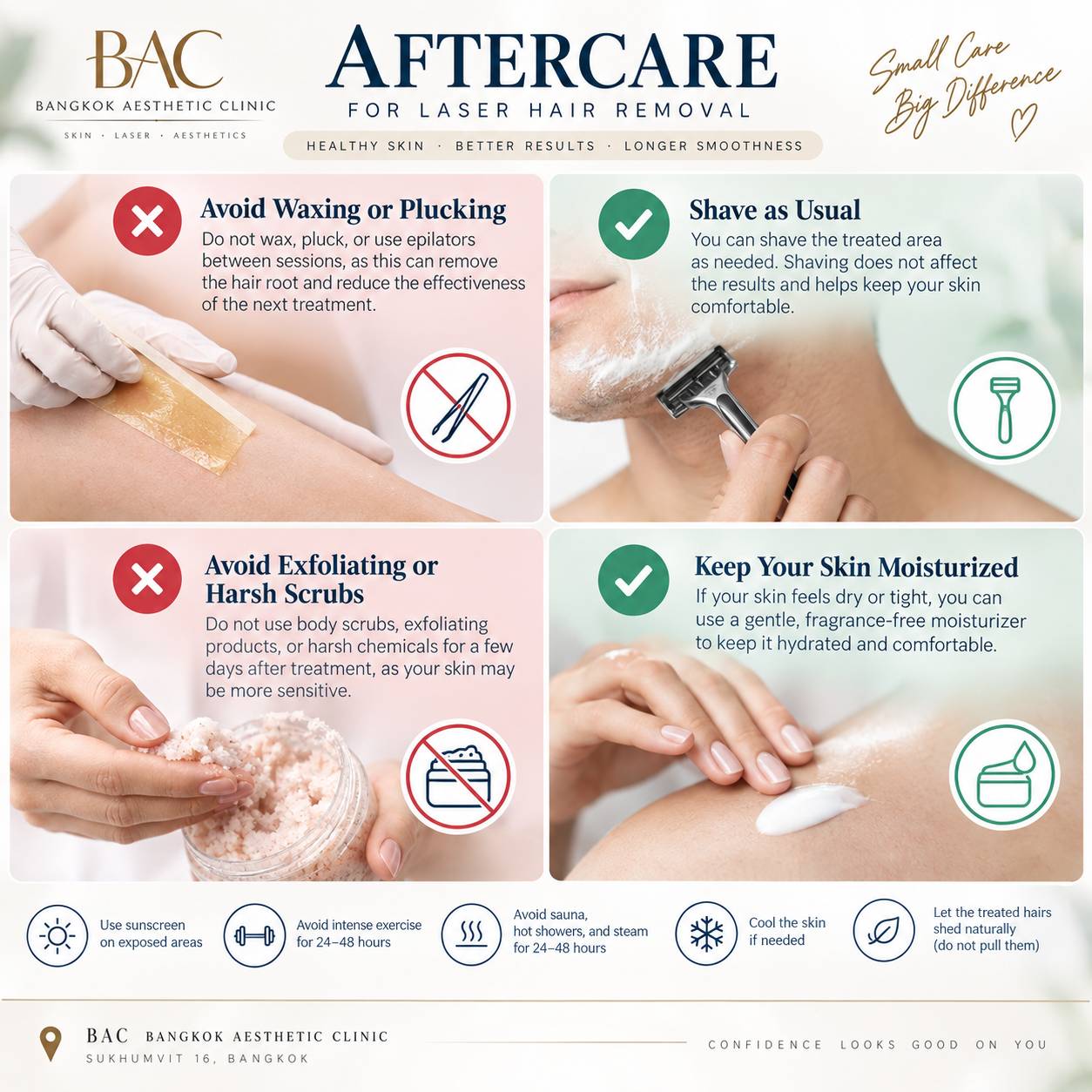
- Avoid waxing, plucking or epilating before treatment.
- Shaving may be recommended depending on the treatment area and clinic protocol.
- Inform the clinic about recent tanning.
- Tell the clinic about recent strong sun exposure.
- Inform the clinic about active skin irritation, infection or open wounds.
- Disclose relevant medications and recent aesthetic procedures.
After Treatment
- Temporary redness or warmth may occur.
- Avoid unnecessary friction immediately after treatment.
- Avoid intense exercise for approximately 48–72 hours when advised.
- Avoid sauna and excessive heat temporarily.
- Use sunscreen on exposed treatment areas.
- Let treated hairs shed naturally.
- Do not pluck treated hairs.
Less Hair. Less Maintenance. More Freedom.
The goal of laser hair reduction does not have to be complete hairlessness.
Some people want:
- Smoother underarms
- Less leg hair
- A cleaner bikini line
- Reduced beard density
- A sharper beard neckline
- Less chest or back hair
A useful treatment plan should match the patient’s own goal rather than forcing everyone toward the same endpoint.

Laser Hair Removal for International Patients in Bangkok
Bangkok serves patients from many ethnic backgrounds and skin tones. This diversity is particularly relevant to laser hair reduction because both skin pigment and hair characteristics affect treatment selection.
BAC Clinic can consider:
- Current skin tone
- Recent tanning
- Hair colour
- Hair diameter
- Hair density
- Body area
- Previous laser treatment
English communication is available. International visitors should understand that laser hair reduction normally requires multiple visits.
BAC Clinic — Sukhumvit 16, Bangkok
Location
- Sukhumvit 16, Bangkok
- Near MRT Queen Sirikit National Convention Centre
- Convenient from BTS Asok / Sukhumvit
- Parking available
Contact BAC Clinic
- LINE: @bacclinic
- Telephone: 02-003-3365
- WhatsApp: +66 96 092 4442
- English service available
Why Choose BAC Clinic for Laser Hair Removal in Bangkok?
Multiple Technologies
BAC Clinic has access to Fotona Long Pulse Nd:YAG, Triple-Wavelength Diode and IPL.
Skin-Tone Consideration
Treatment can consider baseline skin pigmentation and recent tanning.
Hair-Depth Consideration
Fine facial hair, underarm hair and deep beard follicles are different targets.
Cooling Support
Cooling can help improve comfort and manage heat at the skin surface.
Accessible Pricing
Laser hair reduction starts from ฿549.
Central Bangkok Location
Sukhumvit 16 location with English communication available.
Laser Hair Removal Bangkok FAQ
How much does laser hair removal cost in Bangkok?
At BAC Clinic Bangkok, current listed prices start from ฿549 for Upper Lip + Around Mouth. Underarms start from ฿599, Bikini Line from ฿999, Beard + Chin from ฿999, Full Face from ฿1,790, and Brazilian + Anus from ฿2,090 per single session.
Which laser is best for hair removal?
There is no single laser that is automatically best for every patient. Device selection depends on skin pigmentation, hair colour, hair thickness, follicular depth, treatment area, recent sun exposure and previous treatment.
Is Nd:YAG better than Diode?
Neither is universally better. Diode is highly versatile for many treatment areas, while Long Pulse Nd:YAG can be especially important for darker skin or deep coarse terminal hair.
Why is Nd:YAG commonly used for darker skin?
The 1064-nm wavelength has relatively lower absorption by epidermal melanin than several shorter hair-removal wavelengths. This can provide a useful safety advantage when skin pigmentation is higher.
How many laser hair removal sessions do I need?
Approximately 6–8 sessions is a common practical starting framework, but some patients require fewer or more treatments. Area, hair thickness, growth cycle, hormonal influences and response all matter.
Can I shave between laser sessions?
Yes. Shaving is generally preferred over waxing or plucking because the pigmented hair target remains in the follicular unit.
Should I wax before laser hair removal?
Usually no. Waxing or plucking removes the hair shaft from the follicular unit and therefore removes an important laser target.
Does laser hair removal hurt?
Sensation varies. Dense coarse hair may feel more intense than fine hair. Cooling can help improve comfort.
Does laser work on grey or white hair?
Grey, white and very pale hairs generally respond poorly to conventional melanin-targeting lasers because they contain relatively little melanin.
Is laser hair removal suitable for men?
Yes. Common male treatment areas include beard, neck, chest, abdomen, back, arms and legs.
Can laser help with ingrown hairs?
Reducing suitable terminal hair may help some people who experience recurring ingrown hairs or pseudofolliculitis.
Is laser hair removal permanent?
The more accurate term is long-term or progressive hair reduction. Some follicles may remain, and hormonal changes can lead to future regrowth. Maintenance sessions may occasionally be useful.
Can laser hair removal make hair grow more?
Rarely, paradoxical hypertrichosis can occur, meaning hair growth increases rather than decreases in or near the treatment area.
Can tourists get laser hair removal in Bangkok?
Yes, if treatment is suitable. Visitors should understand that laser hair reduction generally requires multiple sessions rather than one appointment.
Can I exercise after laser hair removal?
Many patients are advised to avoid intense exercise, sauna and excessive heat for approximately 48–72 hours after treatment, depending on the treatment area and skin response.
Where is BAC Clinic located?
BAC Clinic is located in Sukhumvit 16, central Bangkok, near MRT Queen Sirikit National Convention Centre and accessible from the Asok/Sukhumvit area.
Scientific References & Further Reading
The following references support general educational information on selective photothermolysis, hair-growth targeting, laser wavelengths, darker skin treatment, Long Pulse Nd:YAG, Diode laser, safety and paradoxical hypertrichosis.
BAC Clinic-specific information such as current pricing, location and available devices comes from BAC Clinic and should not be interpreted as claims made by these publications.
This foundational publication describes selective photothermolysis, the physical principle underlying selective laser targeting of chromophores such as melanin.
PMID: 6836297
Clinical overview covering mechanism of action, Fitzpatrick skin types, commonly used wavelengths, expected treatment course, darker skin considerations and adverse effects.
NCBI Bookshelf ID: NBK507861. PMID: 29939638.
Evidence-based review of laser and light-based hair reduction, including effectiveness, long-term reduction and commonly used systems.
PMID: 16405602
Review discussing Alexandrite, Diode, Nd:YAG and IPL technologies, including treatment considerations for darker skin.
PMID: 23332016
Clinical and histological evaluation of Long Pulse 1064-nm Nd:YAG hair reduction in more pigmented skin phototypes.
PMID: 11453807
Reviews laser treatment in darker skin and discusses the importance of wavelength, epidermal melanin, cooling and parameter selection.
PMID: 14717412
Focused review on hair reduction in darker skin phototypes, emphasizing wavelength selection, safe protocols and treatment parameters.
PMID: 28791605
Comparative clinical study evaluating efficacy, pain and pigmentary side effects in more pigmented skin.
PMID: 14660273
Prospective study evaluating long-term hair reduction after treatment with an 800-nm Diode laser.
PMID: 10816229
Describes paradoxical hypertrichosis, an uncommon complication where hair growth can increase following laser epilation.
PMID: 15965427
Manufacturer information regarding Fotona Nd:YAG technology, hair-reduction applications and device-specific treatment concepts.
https://www.fotona.com/en/treatments/1090/permanent-hair-reduction/
Patient-facing manufacturer information about Fotona 1064-nm Nd:YAG hair reduction, treatment concepts and device-specific expectations.
Start Laser Hair Reduction from ฿549
Ask BAC Clinic which laser technology may be suitable for your skin tone, hair thickness and treatment area.
Individual results vary. Laser hair reduction generally requires multiple sessions. Suitability, device selection and treatment parameters should be assessed individually.
-
Acne Scar Clinic Bangkok | Acne Scar Education | Acne Scar Repair | Acne Scar Revision | Acne Scar Subcision | Acne Scar Treatment
Subcision for Acne Scars Bangkok | Treatment & Price
Discover how subcision helps improve tethered rolling and selected boxcar acne scars by releasing fibrous bands beneath the skin. This comprehensive medical guide from BAC Clinic Bangkok explains blunt cannula versus Nokor techniques, multilayer subcision, treatment outcomes, potential risks, downtime, and the benefits of combining subcision with INFINI Fractional RF Microneedling, TCA CROSS, and other personalized acne scar treatments. Explore treatment options, clinical evidence, pricing, and expert assessment at BAC Clinic in Sukhumvit 16, Bangkok.
-
แชมพูแก้ผมร่วงยี่ห้อไหนดี? ผมร่วงหนัก ผมบางจนเห็นหนังศีรษะ?
การเลือกแชมพูลดผมร่วงควรเริ่มจากเข้าใจหนังศีรษะและสาเหตุของปัญหา BAC Clinic พารู้จักความแตกต่างระหว่างผมขาด ผมหลุดร่วง และผมบาง ก่อนเปรียบเทียบแชมพู 8 สูตรแนะนำปี 2026 นำโดยแชมพูสองนาง อามาร่า พร้อมเจาะลึกพฤกษสาร 10 ชนิด สูตร 14-Free และแนวคิด Scalp First Care รวมถึงวิธีสระและจัดกิจวัตรดูแลเส้นผมอย่างเหมาะสม
-
Lipolysis Injection Bangkok | Targeted Fat Reduction
Discover doctor-led lipolysis injection at BAC Clinic Bangkok for targeted fat reduction and face or body contouring. Compare Fat Off Premium, Neobella® and Red Lava, including key ingredients, prices, treatment areas, approximate intervals and the differences between each program.
-
ดริปวิตามิน Myers’ Cocktail เสริมภูมิคุ้มกัน เติมพลัง ลดความอ่อนล้า
โปรแกรมให้วิตามินทางหลอดเลือด สูตร The Myers’ Cocktail เป็นหนึ่งในสูตร IV Vitamin Therapy ที่มีประวัติยาวนาน โดยมีวิตามินและแร่ธาตุเป็นองค์ประกอบสำคัญ เช่น Vitamin C, B Vitamins, Magnesium และ Calcium เหมาะสำหรับผู้ที่ต้องการเพิ่ม Wellness Routine และช่วงเวลาสำหรับการดูแลตัวเองจากภายใน บทความนี้รวบรวมที่มาของสูตร ส่วนประกอบ แนวทางการทำเป็นคอร์ส การเว้นระยะ ราคา และรายละเอียดโปรแกรมที่ BAC (Bangkok Aesthetic Clinic)
-
เมโสชาแนลคืออะไร? ทำไม NCTF® 135 HA จึงเป็น Skin Booster ที่ได้รับความนิยม
โปรแกรมฉีดชาแนล NCTF® 135 HA Skin Booster 3 mL ที่ BAC Clinic Bangkok ช่วยดูแลความชุ่มชื้น ความเรียบเนียน ความกระจ่างใส และบริเวณใต้ตา ราคาเริ่ม 8,900 บาท
-
Acne Scar Clinic Bangkok | Acne Scar Education | Acne Scar Revision | Acne Scar Subcision | Acne Scar Treatment | คลินิกรักษาหลุมสิว | รักษาหลุมสิว
รักษาหลุมสิวที่ไหนดี? ทำไมหลายคนทำเลเซอร์หลายครั้งแต่หลุมยังไม่ดีขึ้น
ทำไมรักษาหลุมสิวมาหลายครั้งแต่ผิวยังไม่เรียบ? เพราะปัญหาหลุมสิวไม่ได้อยู่เพียงผิวชั้นบน แต่เกี่ยวข้องกับ Dermis หรือชั้นหนังแท้ที่มีโครงสร้างคอลลาเจนอยู่ Program INFINI Fractional Microneedle RF ใช้ Microneedles นำพลังงาน RF ลงสู่ระดับความลึกที่กำหนด เพื่อกระตุ้น Dermal Remodeling พร้อมวางแผนร่วมกับ Subcision, TCA CROSS, Rejuran S, Biostimulator และคอลลาเจนสด ตามชนิดของหลุมสิว