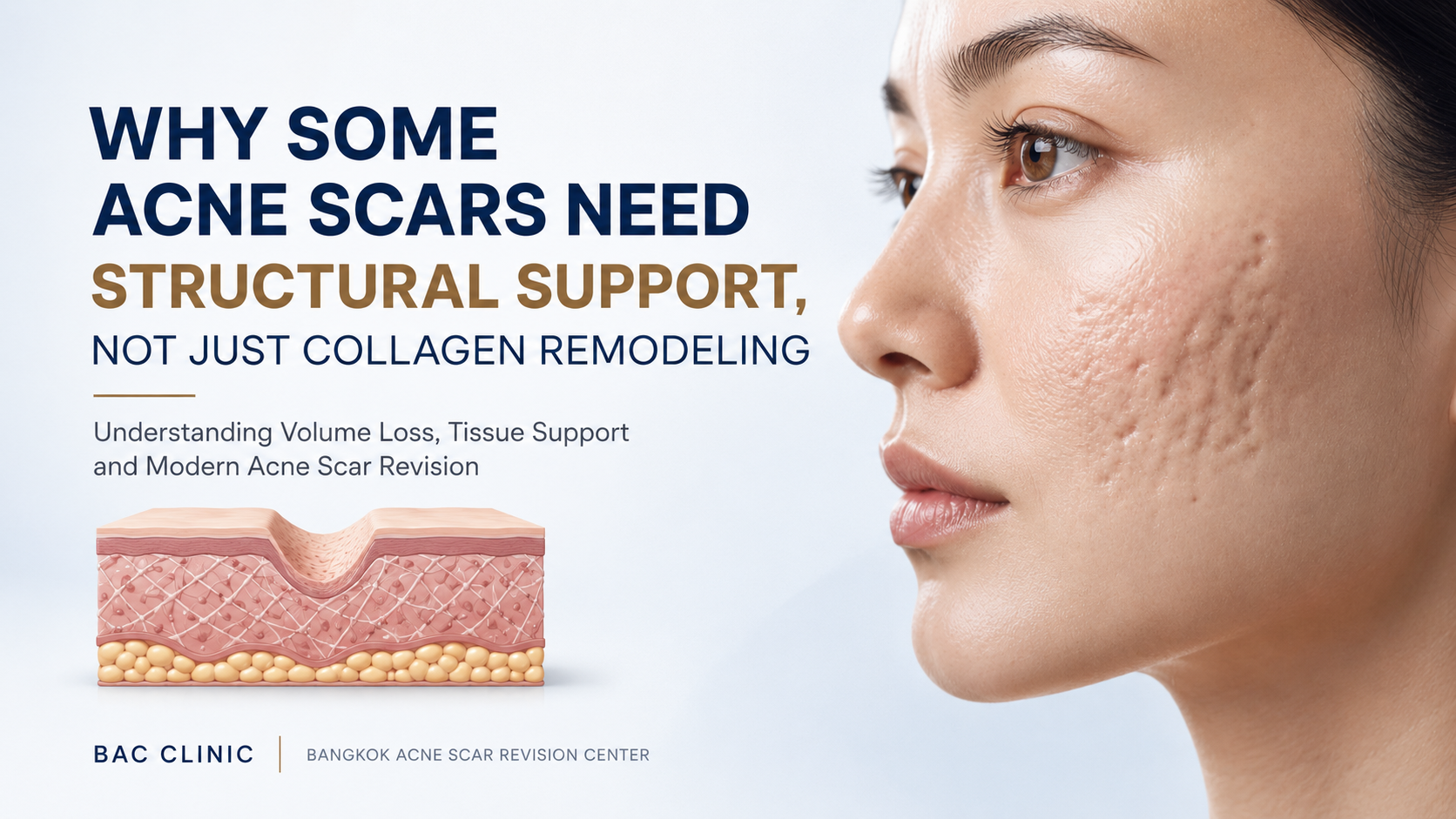
Part 1: Why Some Acne Scars Never Fully Improve After Laser Treatment
One of the most common statements we hear from acne scar patients is surprisingly similar:
“I’ve already had laser treatment several times.”
“I’ve done RF Microneedling.”
“I’ve tried TCA CROSS.”
“My skin texture improved, but the scars still look visible.”
For many patients, this experience is confusing.
After all, modern acne scar treatments are designed to stimulate collagen production. If collagen is being rebuilt, shouldn’t the scars disappear?
The answer is not always.
And the reason may be one of the most misunderstood concepts in acne scar revision:
Not all acne scars are caused by collagen loss alone.
Some acne scars also involve structural volume deficiency.
In other words, the problem is not simply that collagen has been destroyed.
The problem is that the skin and underlying tissue have lost physical support.
This distinction is extremely important because it changes how acne scars should be evaluated and, in some cases, how they should be treated.

The Traditional View of Acne Scars
For many years, acne scar treatment focused almost entirely on collagen.
The logic was straightforward.
Acne inflammation damages collagen.
Scar tissue forms.
The skin becomes depressed.
Therefore:
More collagen = Better scars.
This concept led to the development of treatments such as:
- Fractional Laser
- RF Microneedling
- Microneedling
- TCA CROSS
- Collagen induction therapies
These procedures remain valuable today and continue to play an important role in acne scar revision.
However, clinicians gradually noticed something interesting.
Some patients improved dramatically.
Others improved only partially.
And some patients appeared to hit a plateau despite undergoing multiple collagen-stimulating procedures.
The question became:
Why?
When Collagen Remodeling Is Not the Whole Story
To understand the answer, we need to think about what actually creates the appearance of an acne scar.
Many people assume that a scar is simply a hole in the skin.
But what we see in the mirror is actually a combination of several factors:
- Scar depth
- Scar edge definition
- Skin thickness
- Light reflection
- Fibrosis
- Tissue support
- Facial volume
A scar becomes visible because light interacts with all of these components simultaneously.
This explains why two scars of similar depth can look completely different.
One scar may appear mild.
The other may appear severe.
Even though both measure the same depth.
The difference often lies in structural support.
Understanding Structural Support
Imagine a mattress.
If the mattress cover becomes slightly damaged, replacing the fabric may solve the problem.
But what if the springs underneath are broken?
In that situation, replacing the fabric alone will not restore the mattress.
The underlying support structure remains compromised.
Acne scars can behave in a similar way.
Many treatments focus on improving the skin itself.
However, some scars also involve loss of support beneath the skin.
When this occurs, collagen remodeling may improve the surface while leaving deeper deficiencies relatively unchanged.
This is one reason why some patients continue to notice depressions despite visible improvements in texture.
What Is Volume Loss?
Volume loss refers to a reduction in tissue support beneath the skin.
This support may include:
- Dermal tissue
- Subcutaneous tissue
- Fat compartments
- Connective tissue
- Structural collagen networks
When these structures are diminished, the skin loses its foundation.
The result may appear as:
- Persistent depressions
- Facial hollowness
- Scar visibility
- Uneven contours
Many patients assume this only happens with aging.
In reality, acne itself can contribute to localized volume loss.
Especially when inflammation is severe or prolonged.

How Severe Acne Can Create Volume Deficiency
Inflammatory acne is not a superficial condition.
Deep cysts and nodules often extend far beneath the skin surface.
As inflammation progresses, several processes occur simultaneously.
Collagen Destruction
Inflammatory mediators break down collagen.
Tissue Remodeling
Normal tissue architecture becomes disrupted.
Fibrosis
Scar tissue forms.
Fat Atrophy
In some cases, surrounding fat compartments become reduced.
Structural Collapse
The skin loses some of its underlying support.
When healing occurs, the body may not completely restore what was lost.
This leaves behind not only a scar but sometimes a localized volume deficiency.
Why Volume Loss Is Often Missed
One reason volume loss is frequently overlooked is because it cannot always be seen directly.
Patients usually focus on the surface.
They see:
- Holes
- Pits
- Shadows
- Texture changes
But beneath the surface, there may be additional structural changes that contribute to the scar’s appearance.
These changes become particularly important in patients who have:
- Long-standing scars
- Multiple treatment histories
- Broad boxcar scars
- Extensive atrophic scarring
- Facial volume depletion
In these cases, collagen stimulation alone may not fully address the underlying problem.
The Difference Between Scar Depth and Volume Loss
These two concepts are often confused.
However, they are not the same.
Scar Depth
Scar depth refers to how far the scar extends below the surrounding skin surface.
This is what most people think of when they imagine a depressed acne scar.
Volume Loss
Volume loss refers to the absence of tissue support beneath the scar.
A scar may be relatively shallow but still appear noticeable because supporting tissue is lacking.
Conversely, a deeper scar may appear less obvious if surrounding tissue remains healthy and supportive.
Understanding this distinction is one of the keys to modern acne scar revision.
Why Some Patients Plateau After Multiple Treatments
Many patients reach a point where further collagen stimulation produces diminishing returns.
For example:
A patient undergoes:
- RF Microneedling
- RF Microneedling
- RF Microneedling
- Additional laser treatment
The skin quality improves.
Pores improve.
Texture improves.
Yet certain scars remain stubbornly visible.
This is often where structural evaluation becomes important.
The remaining issue may not be collagen production.
The remaining issue may be support.
Without adequate support, collagen remodeling alone may have limitations.

Understanding Different Treatment Goals
Concept
Light Reflection: The Hidden Factor
One of the most overlooked concepts in acne scar revision is light.
What patients perceive as a scar is often a combination of anatomy and shadow.
Light strikes the skin.
Depressions create shadows.
The brain interprets these shadows as defects.
When structural support is restored, several things may happen:
- Shadows become softer
- Light reflection improves
- Surface transitions appear smoother
- Scars become less noticeable
This is why improvement is not always about making a scar disappear.
Sometimes it is about changing how the scar interacts with light.
And that can significantly alter how visible it appears.
Why Two Patients With Similar Scars Can Look Completely Different
This phenomenon becomes easier to understand when structural support is considered.
Patient A and Patient B may both have:
- Boxcar scars
- Similar depth
- Similar location
Yet one appears dramatically more scarred.
Why?
Potential reasons include:
- Different dermal thickness
- Different collagen density
- Different volume support
- Different scar edge quality
- Different tissue architecture
In other words, scars are not simply holes.
They are three-dimensional structural changes.
The Shift Toward Structural Acne Scar Revision
Over the last decade, acne scar treatment has evolved significantly.
Instead of viewing scars solely as collagen deficiencies, specialists increasingly recognize the importance of structural anatomy.
Modern acne scar revision now considers:
- Scar tethering
- Scar edges
- Dermal thickness
- Tissue support
- Volume deficiency
- Light reflection
This broader perspective helps explain why treatment plans have become more sophisticated.
Today, many advanced treatment strategies involve combining multiple approaches rather than relying on a single procedure.
Part 2: Understanding Structural Support and Why Some Acne Scars Need More Than Collagen Stimulation
In Part 1, we discussed one of the most overlooked concepts in acne scar treatment:
Not every acne scar is simply a collagen problem.
Some scars also involve a loss of structural support beneath the skin.
This distinction helps explain why certain patients continue to see visible depressions even after multiple collagen-stimulating treatments.
The next question becomes:
What exactly provides structural support beneath the skin?
To answer that question, we need to look deeper than the scar itself.
We need to understand the architecture of the face.
The Skin Is Not a Flat Surface
When people look at their skin in the mirror, they usually see only the surface.
But beneath that surface exists a highly complex three-dimensional structure.
The face is composed of multiple layers:
Epidermis
The outermost skin layer.
Dermis
The collagen-rich support layer.
Subcutaneous Tissue
Fat and connective tissue beneath the dermis.
Retaining Ligaments
Structural connections that help maintain facial shape.
Muscle
Provides movement and facial expression.
Bone
The deepest structural foundation.
All of these layers contribute to how the skin looks from the outside.
When acne scars form, they can affect more than one layer simultaneously.
Why Acne Scars Are Not Just Skin Deep
Many patients imagine acne scars as superficial defects.
In reality, severe inflammatory acne may damage tissue at multiple levels.
Deep cystic acne can trigger:
- Collagen destruction
- Fat atrophy
- Scar tethering
- Fibrosis
- Structural collapse
The deeper the inflammation extends, the greater the potential for long-term structural changes.
This is particularly important in patients with severe cystic acne that persisted for years before treatment.
By the time healing occurs, the skin may have lost not only collagen but also some of its underlying support framework.
Understanding the Dermis
The dermis is often the primary target of acne scar treatments.
This layer contains:
- Collagen fibers
- Elastin fibers
- Blood vessels
- Fibroblasts
When acne inflammation destroys collagen, the dermis becomes thinner and weaker.
This is one reason why procedures such as:
- RF Microneedling
- Fractional Laser
- TCA CROSS
focus heavily on stimulating collagen production.
These treatments help rebuild dermal support.
For many patients, this approach is highly effective.
However, not every scar problem originates exclusively within the dermis.
What Happens Beneath the Dermis?
Directly beneath the dermis lies the subcutaneous layer.
This region contains:
- Fat compartments
- Connective tissue
- Vascular structures
These tissues help support the skin from below.
Think of them as part of the foundation supporting a building.
If the foundation weakens, the structure above becomes less stable.
The same principle applies to facial anatomy.
When volume support decreases, the overlying skin may appear more depressed.
Even if the skin itself is relatively healthy.
Localized Volume Deficiency After Acne
Volume loss does not always affect the entire face.
Sometimes it is highly localized.
This is particularly relevant in acne scar patients.
After years of inflammation, some areas may develop:
- Fat atrophy
- Tissue contraction
- Structural deficiency
The resulting depression may appear as a scar.
However, the visible defect may not be caused entirely by collagen loss.
Part of the problem may involve missing support beneath the skin.
This concept is sometimes referred to as:
Structural Volume Deficiency
And it plays a larger role in acne scar visibility than many patients realize.
Why Some Boxcar Scars Remain Visible
Boxcar scars are often considered collagen-loss scars.
That is true.
But it is not always the whole story.
Many boxcar scars also involve:
- Tissue deficiency
- Structural collapse
- Dermal thinning
- Reduced support beneath the scar
As a result, stimulating collagen alone may improve the scar without completely eliminating its visibility.
The scar becomes better.
But not fully corrected.
This is one reason why some patients continue searching for answers after multiple treatment sessions.
Understanding Facial Support Like a Building
Imagine a building supported by several pillars.
If one pillar becomes damaged, the floor above may begin to sag.
Repairing the flooring helps.
But if the pillar remains weak, the sagging may persist.
Acne scars can behave similarly.
Collagen stimulation improves the skin.
However, if deeper support structures remain compromised, improvement may eventually plateau.
The goal then becomes not only rebuilding collagen but also restoring support.

Modern 3D Acne Scar Revision
Why Light Makes Structural Deficiency More Obvious
One of the most important concepts in acne scar revision is how light interacts with facial anatomy.
Patients rarely notice scars in completely flat lighting.
Instead, scars become most visible when:
- Sunlight hits from the side
- Overhead lighting creates shadows
- Camera flash emphasizes contours
These lighting conditions highlight differences in facial topography.
When support beneath the skin is reduced, depressions cast stronger shadows.
This increases scar visibility.
Interestingly, improving support can sometimes reduce shadow formation even before a scar is completely filled.
This is one reason why structural improvement can have a disproportionately large effect on appearance.
Why Some Patients Respond Better Than Others
Patients often compare their results with others.
They wonder:
Why did that person improve after two treatments while my scars remain visible?
The answer often involves anatomy.
Every patient begins with a different combination of:
- Scar depth
- Dermal thickness
- Tissue support
- Facial volume
- Healing capacity
A patient with strong underlying support may respond very well to collagen stimulation alone.
A patient with significant volume deficiency may require a broader treatment strategy.
Neither patient is doing anything wrong.
They simply have different anatomical challenges.
The Difference Between Improving a Scar and Supporting a Scar
This distinction is becoming increasingly important in modern acne scar revision.
Improving a Scar
May involve:
- Stimulating collagen
- Softening scar edges
- Remodeling tissue
Supporting a Scar
May involve:
- Restoring structural volume
- Improving tissue architecture
- Enhancing support beneath the skin
Both approaches can be valuable.
The key is determining which problem contributes most to the scar’s appearance.
Why Repeated Collagen Stimulation Has Limits
Collagen remodeling remains one of the foundations of acne scar treatment.
However, there is a practical reality.
If a scar has already undergone multiple rounds of collagen stimulation, additional treatments may eventually provide diminishing returns.
This does not mean treatment has failed.
It simply means the remaining problem may no longer be primarily collagen-related.
At that point, structural factors become increasingly important.
This realization has influenced how many acne scar specialists approach complex cases today.
Modern Acne Scar Revision Is Becoming More Individualized
Historically, acne scar treatment often followed a simple formula.
Scar equals collagen loss.
Therefore:
Stimulate collagen.
Today, specialists recognize that scars vary dramatically between patients.
Treatment planning increasingly considers:
- Scar type
- Scar depth
- Scar edges
- Tethering
- Volume deficiency
- Tissue support
- Facial anatomy
This shift represents one of the most important developments in acne scar treatment over the past decade.
Instead of focusing solely on procedures, clinicians are focusing more on understanding the actual anatomy of the scar.
Why This Matters for Patients
Understanding structural support changes expectations.
Patients begin to realize that:
- Not all scars are the same.
- Not all depressions are caused by collagen loss.
- More treatments do not always mean better outcomes.
- Treatment should target the cause of the scar’s visibility.
This perspective often leads to more realistic treatment plans and more satisfying outcomes.
Understanding this relationship is one of the keys to modern acne scar revision.
Part 3: Structural Support Treatments — When Collagen Remodeling Alone May Not Be Enough
In Part 1 and Part 2, we explored a concept that many acne scar patients have never heard before:
Not every depressed acne scar is caused entirely by collagen loss.
Some scars also involve:
- Structural volume deficiency
- Tissue support loss
- Dermal thinning
- Architectural collapse beneath the skin
Understanding this distinction helps explain why certain patients experience significant improvement after collagen-stimulating procedures, while others continue to see visible depressions despite undergoing multiple treatments.
The next question naturally becomes:
If some scars need support, what exactly does “structural support” mean?
And perhaps more importantly:
How do clinicians address it?
Structural Support Does Not Mean “Filling the Scar”
One of the biggest misconceptions in acne scar treatment is that structural support simply means injecting filler directly into a depression.
Modern acne scar revision is much more sophisticated than that.
The goal is not necessarily to “fill a hole.”
The goal is to improve the overall support system beneath the skin.
This support may involve:
- Hydration
- Tissue quality
- Collagen stimulation
- Extracellular matrix function
- Structural reinforcement
Different products achieve these goals in different ways.
This is why not every injectable behaves the same.
And it is why understanding the role of each product is more important than simply choosing a brand name.
The Evolution of Acne Scar Treatment
Ten years ago, acne scar treatment largely revolved around:
- Lasers
- Subcision
- TCA CROSS
- Dermabrasion
Today, regenerative medicine has added a completely new category of treatment.
Instead of focusing solely on destroying damaged tissue and rebuilding collagen, clinicians can now work on improving the biological environment of the skin itself.
This shift has introduced treatments such as:
- Polynucleotides
- Skin boosters
- Hybrid fillers
- Biostimulators
- Structural support injectables
Each plays a different role.
Understanding Skin Quality vs Structural Support
Before discussing individual products, it is important to understand a distinction that many patients miss.
Skin Quality
Refers to:
- Hydration
- Elasticity
- Texture
- Radiance
- Dermal health
Structural Support
Refers to:
- Mechanical support
- Tissue volume
- Architectural stability
- Resistance to collapse
A patient may have excellent skin quality yet still have visible acne scars.
Conversely, a patient may have poor skin quality but relatively mild scarring.
Because these are different problems, they often require different treatment strategies.
Restylane Vital Light: More Than a Traditional Filler
One product that frequently enters discussions about acne scar revision is Restylane Vital Light.
Many patients mistakenly assume it is simply another filler.
In reality, its role is somewhat different.
The product is designed primarily for:
- Skin hydration
- Dermal support
- Skin quality improvement
Rather than creating large amounts of volume, it provides subtle support within the dermis.
This can be particularly relevant in acne scar patients with:
- Thin skin
- Dermal depletion
- Mild volume deficiency
The goal is not dramatic augmentation.
The goal is improving the quality and support of the tissue itself.
Why Some Acne Scar Patients Benefit from Dermal Support
Imagine two patients with identical scars.
Patient A has thick, healthy skin.
Patient B has thin, depleted skin.
Even if the scars are identical, they may appear very different.
Thin skin often:
- Reflects light differently
- Reveals depressions more easily
- Provides less support
Improving dermal support can sometimes reduce scar visibility even when scar depth remains relatively unchanged.
This concept is often overlooked.
Yet it is becoming increasingly important in modern acne scar revision.
Belotero Revive: Where Skin Quality Meets Structural Support
Belotero Revive occupies an interesting position between traditional skin boosters and structural support treatments.
The product combines:
- Hyaluronic acid
- Glycerol
The intention is not massive volumization.
Instead, the goal is improving:
- Hydration
- Elasticity
- Tissue quality
In selected patients, these improvements can contribute to better light reflection and smoother transitions around scars.
Again, this is not about “filling holes.”
It is about improving the environment surrounding the scar.
Why Scar Visibility Is Not Always About Depth
Many patients focus exclusively on depth.
However, visibility is influenced by several factors:
- Scar depth
- Scar edge definition
- Tissue quality
- Skin thickness
- Hydration
- Structural support
A scar can become less noticeable even if its measured depth changes only modestly.
Why?
Because the way it interacts with light changes.
The surrounding tissue changes.
The skin becomes more supportive.
This concept helps explain why some patients report meaningful cosmetic improvement despite relatively small objective changes.
Profhilo: A Different Philosophy
Profhilo has attracted significant attention because it behaves differently from both traditional fillers and traditional skin boosters.
Instead of focusing primarily on volume, Profhilo aims to improve tissue quality through bio-remodeling.
The treatment may contribute to:
- Improved hydration
- Better elasticity
- Enhanced tissue quality
For acne scar patients, this can be relevant because healthier tissue often responds better to other scar treatments.
However, it is important to understand what Profhilo does not do.
Profhilo is not designed to:
- Release tethered scars
- Replace deep volume loss
- Correct severe structural depressions
Its strength lies in improving the biological environment of the skin.
Rejuran and Tissue Regeneration
Another treatment frequently discussed in acne scar revision is Rejuran.
Unlike fillers, Rejuran focuses on tissue regeneration.
The product contains polynucleotides designed to support healing and repair processes.
Potential benefits include:
- Improved skin quality
- Enhanced healing
- Better tissue resilience
- Improved dermal environment
Many specialists view Rejuran as a complementary treatment rather than a standalone solution for severe acne scars.
Its role is often to improve tissue quality while other procedures address structural defects.
Biostimulators: Encouraging the Body to Build Its Own Support
One of the most exciting developments in aesthetic medicine is the emergence of biostimulators.
Unlike traditional fillers, biostimulators work primarily by encouraging the body to create its own collagen.
Examples may include treatments designed to stimulate long-term tissue remodeling rather than immediate volume replacement.
The philosophy is fundamentally different.
Instead of adding support directly, the treatment encourages the body to generate support gradually.
For certain acne scar patients, this can be particularly valuable.
Why Structural Support and Collagen Remodeling Are Not Opposites
Patients sometimes assume they must choose between:
Collagen Remodeling
or
Structural Support
In reality, the most successful acne scar treatments often involve both.
Think of a building.
Collagen remodeling improves the walls.
Structural support strengthens the foundation.
Both are important.
A building with excellent walls but a weak foundation still has problems.
A building with a strong foundation but damaged walls also has problems.
The same principle applies to acne scars.
Modern Acne Scar Revision Is About Layering Treatments
One of the biggest shifts in acne scar treatment is the movement away from single-treatment thinking.
Instead of asking:
What is the best treatment?
Clinicians increasingly ask:
What combination of treatments addresses all aspects of this scar?
That combination may include:
Subcision
For tethering.
RF Microneedling
For collagen remodeling.
TCA CROSS
For deep scar reconstruction.
Rejuran
For tissue quality.
Profhilo
For bio-remodeling.
Restylane Vital Light
For dermal support.
Belotero Revive
For hydration and skin quality.
Each treatment contributes something different.
Why Patient Selection Matters
Not every patient needs structural support.
Some patients improve dramatically with:
- Subcision
- RF Microneedling
- TCA CROSS
alone.
Others may continue to exhibit:
- Tissue deficiency
- Thin skin
- Volume depletion
These patients may require a broader treatment strategy.
This is why individualized assessment remains one of the most important aspects of acne scar revision.
Part 4: When Structural Support Matters, Common Mistakes and the Future of Modern Acne Scar Revision
After discussing collagen remodeling, volume loss, tissue support, skin boosters, polynucleotides, and structural support therapies, we arrive at perhaps the most important question of all:
How do clinicians determine when an acne scar requires structural support rather than additional collagen stimulation alone?
This question has become increasingly important as acne scar treatment continues to evolve.
Twenty years ago, most treatment plans focused almost entirely on resurfacing the skin.
Today, clinicians recognize that acne scars are often multi-layered structural problems.
Understanding those layers is the key to successful treatment.
The Hidden Reason Some Acne Scars Never Fully Improve
Many patients experience a similar journey.
They begin with laser treatment.
Their skin texture improves.
Pores become smaller.
The skin becomes smoother.
But certain scars remain stubbornly visible.
The patient then undergoes additional treatments.
More collagen stimulation.
More resurfacing.
More sessions.
Yet some depressions remain.
Why?
Because the remaining issue may no longer be collagen deficiency.
The remaining issue may be structural support.
This concept helps explain why some patients reach a plateau despite multiple treatments.
The skin itself improves.
The architecture beneath the skin does not improve to the same degree.
How Clinicians Identify Volume-Deficient Acne Scars
Volume deficiency is not diagnosed simply by looking at scar depth.
Instead, clinicians evaluate multiple characteristics.
Scar Behavior Under Different Lighting
One clue is how the scar behaves under light.
Volume-deficient scars often create:
- Persistent shadows
- Deep contour changes
- Structural depressions
even after collagen remodeling has improved the surrounding skin.
Tissue Thickness
Thin skin often reveals structural deficiencies more clearly.
The thinner the tissue, the easier it becomes to see underlying contour irregularities.
Scar Distribution
Some patients have isolated scars.
Others have broad areas of atrophic change.
Widespread tissue deficiency often suggests that support structures have been affected in addition to collagen.
Previous Treatment History
Patients who have already undergone multiple collagen-stimulating procedures provide important information.
If collagen remodeling has occurred but visibility remains, structural factors become increasingly relevant.
Why More Treatment Is Not Always Better
One of the most common mistakes in acne scar treatment is assuming that additional procedures automatically produce better outcomes.
This is not always true.
Imagine a patient who has already completed:
- Several RF Microneedling sessions
- Multiple laser treatments
- TCA CROSS procedures
If the primary remaining issue is structural support, repeating the same collagen-focused treatment may yield diminishing returns.
The challenge is not necessarily lack of treatment.
The challenge is identifying what problem still remains.
Modern acne scar revision increasingly focuses on answering that question.
Understanding Treatment Plateaus
Treatment plateaus are common.
Patients often describe them as:
“The first few sessions helped a lot, but then progress slowed.”
This observation is frequently accurate.
Early treatment often addresses:
- Active tethering
- Significant collagen deficiency
- Surface irregularity
Once these issues improve, remaining imperfections may stem from different mechanisms.
At this stage, clinicians often reevaluate the scar rather than simply repeating previous procedures.
Why Some Patients Need a Layered Treatment Strategy
Acne scars rarely result from a single problem.
Instead, they often involve multiple overlapping factors.
For example:
Problem 1
Scar tethering.
Problem 2
Collagen loss.
Problem 3
Scar edge definition.
Problem 4
Structural volume deficiency.
Problem 5
Poor tissue quality.
Each problem contributes differently to scar visibility.
This explains why combination therapy has become increasingly important.
Instead of treating the scar as a single defect, specialists address the individual components separately.
A Modern Example of Layered Acne Scar Revision
Consider a patient with:
- Rolling scars
- Boxcar scars
- Thin skin
- Localized volume deficiency
A modern treatment strategy might involve:
Step 1
Subcision
To release scar tethering.
Step 2
RF Microneedling
To stimulate collagen remodeling.
Step 3
TCA CROSS
For deep focal scars.
Step 4
Polynucleotide treatment
To improve tissue quality.
Step 5
Structural support therapy
For areas exhibiting persistent volume deficiency.
Notice that no single treatment is expected to solve every problem.
Each procedure serves a specific purpose.
This approach reflects how acne scar treatment is increasingly practiced today.
Common Mistakes Patients Make
Mistake 1: Focusing Only on Technology
Patients often ask:
Which laser is best?
The better question is:
What is causing the scar to remain visible?
Technology matters.
Diagnosis matters more.
Mistake 2: Comparing Results With Other Patients
Every scar is different.
Every face is different.
Every healing response is different.
A treatment that works extremely well for one patient may produce different results in another.
Mistake 3: Expecting Complete Scar Removal
Modern treatments can often achieve meaningful improvement.
However, ethical clinicians avoid promising perfection.
The goal is usually improvement rather than complete elimination.
Mistake 4: Assuming Every Depression Is Collagen Loss
As discussed throughout this article, some depressions involve structural support issues as well.
Failing to recognize this distinction can lead to unrealistic expectations.
The Relationship Between Aging and Acne Scars
An interesting aspect of acne scar treatment is that aging can influence scar visibility.
As facial support naturally decreases with age:
- Skin becomes thinner
- Collagen declines
- Fat compartments change
- Tissue support decreases
Existing scars may become more noticeable.
This is one reason why some patients report that scars they barely noticed in their twenties become more visible in their thirties or forties.
The scar itself has not necessarily changed.
The surrounding support structures have.
Why Acne Scar Revision Is Becoming More Personalized
Historically, treatment recommendations were often based primarily on scar type.
Today, clinicians increasingly consider:
- Scar type
- Scar depth
- Tissue quality
- Skin thickness
- Facial anatomy
- Volume support
- Healing biology
This personalized approach reflects a deeper understanding of acne scar pathology.
It also helps explain why two patients with similar scars may receive very different treatment recommendations.
The Future of Acne Scar Treatment
The future of acne scar revision is likely to involve increasingly sophisticated combinations of:
- Scar release
- Collagen remodeling
- Tissue regeneration
- Structural support
- Biostimulation
Rather than focusing on a single technology, clinicians are increasingly focused on understanding how different treatments complement one another.
This shift represents one of the most significant developments in aesthetic medicine.
Frequently Asked Questions
Does every acne scar patient need structural support?
No.
Many patients improve substantially with collagen remodeling procedures alone.
Structural support becomes more relevant when tissue deficiency contributes significantly to scar visibility.
Is structural support the same as filler?
Not necessarily.
Structural support is a broader concept.
It may involve:
- Dermal support
- Tissue quality improvement
- Biostimulation
- Volume restoration
Different products achieve these goals in different ways.
Can collagen remodeling and structural support be combined?
Absolutely.
In fact, they are often complementary rather than competing approaches.
Many modern treatment plans incorporate both.
How do I know whether my scars involve volume loss?
This usually requires professional assessment.
Factors such as tissue thickness, scar behavior, facial anatomy, and treatment history all contribute to the evaluation.
Final Thoughts
One of the most important lessons in modern acne scar revision is that scars are not simply holes in the skin.
They are complex structural changes involving:
- Collagen
- Tissue quality
- Scar edges
- Fibrosis
- Tethering
- Volume support
- Light reflection
This broader understanding helps explain why some patients improve dramatically with collagen stimulation while others require additional support strategies.
Perhaps the most important takeaway is this:
Not every visible acne scar is asking for more collagen.
Some scars are asking for better support.
The future of acne scar treatment is not about choosing between collagen remodeling and structural support.
It is about understanding when each approach is appropriate and how they can work together to create more natural, balanced, and meaningful improvement.
That shift—from treating scars as simple depressions to viewing them as complex structural changes—represents one of the most important advances in acne scar revision today.
Contact BAC Clinic
📍 BAC Clinic (Bangkok Aesthetics Clinic)
180 Sukhumvit Soi 16, Sixteen Place Building, 1st Floor
Khlong Toei, Bangkok 10110, Thailand
📞 Phone:
+66 2 003 3365
💬 LINE Official Account:
@bacclinic
🌐 Acne Scar Center:
www.bangkokacnescarrevision.com
📸 Instagram:
@bac_clinic
⏰ Opening Hours:
Tuesday – Friday: 11:00 AM – 8:00 PM
Saturday – Sunday: 11:00 AM – 7:00 PM
Closed on Mondays
🚆 Getting Here:
BAC Clinic is conveniently located in Sukhumvit Soi 16, within walking distance from BTS Asok Station and MRT Sukhumvit Station.
Appointment Required
BAC Clinic operates by appointment only and does not accept walk-in patients. Advance booking is required to ensure doctor availability and sufficient consultation time.
Complimentary Consultation
Consultations are free of charge. Depending on the doctor’s assessment and schedule, eligible patients may proceed with treatment on the same day.