Treated Your Acne Scars Again and Again — Why Are Some Scars Still There?
Sometimes the answer is not to use a stronger laser. The more important question is whether treatment is reaching the layer where the scar structure actually exists.
Atrophic acne scars may involve collagen loss, dermal thinning and fibrous tethering beneath the visible surface. Program INFINI Fractional Microneedle RF uses microneedle electrodes to deliver radiofrequency energy to selected levels of the dermis, creating controlled thermal zones that initiate tissue repair and collagen remodeling.
Acne scars are not simply a surface problem
The depression visible in the mirror is only the surface expression of an atrophic scar. Beneath it, previous inflammation may have damaged collagen, reduced dermal support or created fibrous bands that anchor the scar downward.
This is why post-acne pigmentation and true atrophic acne scars should not be approached as exactly the same problem. Pigmentation concerns skin color, while an atrophic scar involves structural changes within the skin.
From scar anatomy to a personalized treatment plan
“I have treated my acne scars for years. Why are some depressions still almost unchanged?”
This question changes the way we think about acne scar treatment. Instead of asking which device is the most expensive or which treatment feels the strongest, a more useful question is: where is the scar structure located, and does the treatment actually reach it?
The dermis lies beneath the epidermis and contains much of the skin’s collagen, elastin and extracellular matrix. When deep inflammatory acne damages this supporting structure, healing does not always restore the original architecture perfectly.
Some areas are left with insufficient dermal support. Other scars develop fibrous attachments that pull the surface downward. Some form narrow scar tracts extending deeper into the skin.
This is why acne scar revision may require more than simply resurfacing the visible top layer.
The acne may be gone, but the dermis may never have fully returned to its original structure
Papules, pustules and deeper inflammatory acne can affect tissue underneath the epidermis. During healing, collagen may be lost, the dermal matrix may become irregular, or fibrous bands may attach the surface to deeper tissue.
A broad depression associated with tethering may appear as a Rolling Scar. A defined depression may resemble a Boxcar Scar. A narrow opening extending deeply into the skin may be classified as an Ice Pick Scar.
These are not simply different names for the same problem. They represent different scar architectures.
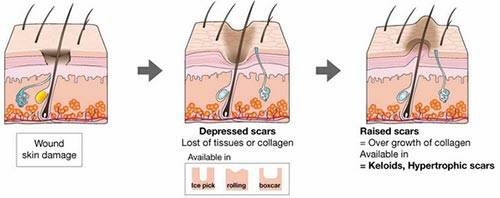
BAC Clinic therefore approaches acne scars as Acne Scar Revision rather than treating every depression as a generic “laser scar.”
One area may need fibrous release. Another may need dermal remodeling. Another may require focal treatment inside the scar itself.
Controlled thermal stimulation gives the dermis a reason to begin repairing again
Energy-based acne scar treatment uses a deliberate biological principle: create controlled tissue stimulation and allow the body’s healing response to rebuild and reorganize tissue over time.
When appropriate thermal energy reaches target tissue, a localized coagulation zone is created. The healing response then progresses through cellular activity, matrix remodeling and progressive collagen reorganization.
The location of that thermal effect matters. Surface redness alone does not prove that energy has reached the level involved in the scar.
The supporting skin layer containing collagen and structural matrix.
A controlled area of thermal effect designed to initiate tissue repair.
Progressive rebuilding and reorganization of collagen and supporting dermal structure after healing begins.
The key is not simply creating heat — it is placing controlled thermal energy at the intended dermal level
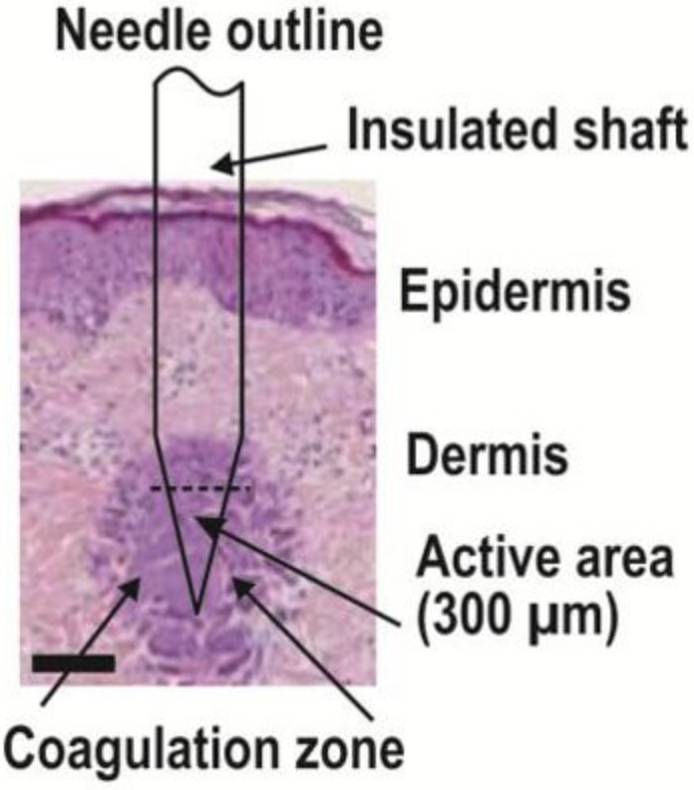
The needle shaft is insulated while the active RF electrode is located toward the distal portion of the microneedle. RF energy is released around this active area, producing a localized thermal coagulation zone within the targeted tissue.
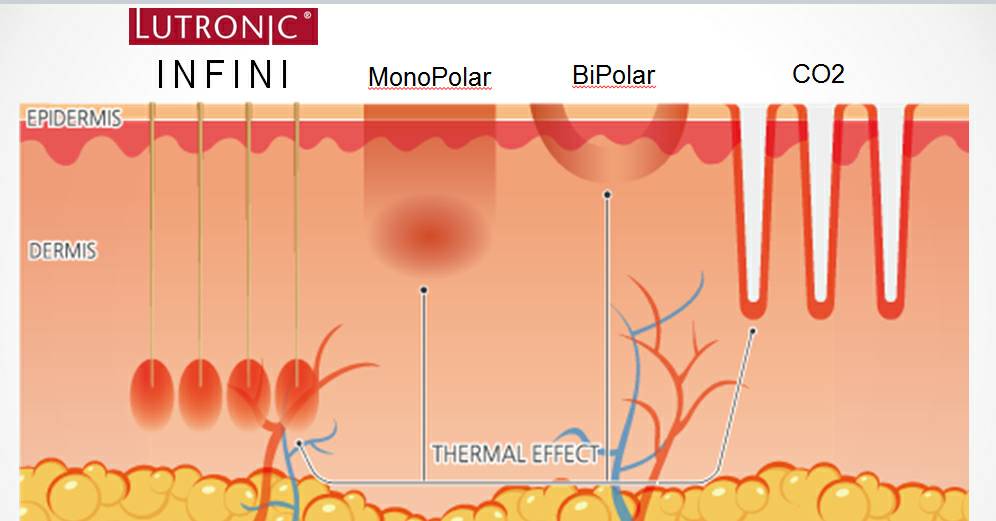
Program INFINI positions microneedle electrodes within the skin before RF energy is delivered. This is different from technologies that begin energy delivery from the surface.
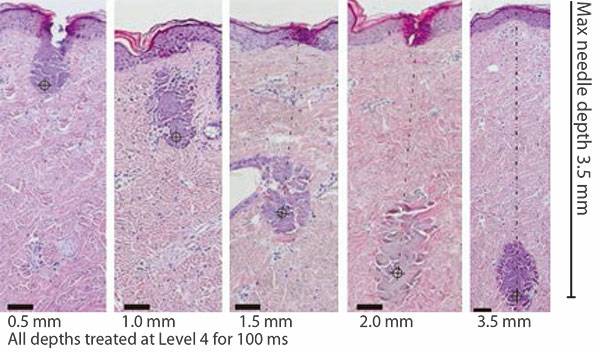
The histologic images illustrate treatment at different microneedle depths, including levels from approximately 0.5 mm to 3.5 mm.
This helps explain why acne scar treatment should focus on the appropriate tissue level rather than automatically using one depth across the entire face.
Acne scar technologies use different pathways to create controlled tissue remodeling
Ablative Resurfacing
Ablative technologies such as fractional CO₂ laser create controlled injury beginning at the skin surface. They remain established resurfacing options, although recovery time, prolonged erythema and post-inflammatory pigmentation may be important considerations.
Fractional Laser
Fractional treatment divides treatment into microscopic treatment zones, leaving intervening tissue to assist recovery.
Radiofrequency
Radiofrequency creates thermal energy through electrical resistance within tissue.
Microneedle RF
Microneedle RF first positions electrodes at a selected tissue level and then releases RF energy. Treatment depth therefore becomes an important part of acne scar planning.
The microneedles do more than puncture the skin — they carry RF energy to a selected dermal level
Program INFINI Fractional Microneedle RF uses a 7 × 7 array containing 49 microneedle electrodes.
Treatment depth can be adjusted from approximately 0.5 to 3.5 mm, allowing different areas to be treated according to facial anatomy and scar morphology.
Fractional 7 × 7 microneedle electrode array.
Adjustable treatment depth for different dermal levels.
Treatment depth can be adapted according to the scar map rather than using one setting everywhere.
Why do insulated microneedles matter?
With an insulated microneedle design, most of the needle shaft is insulated while RF energy is released around the active electrode region.
The clinically important concept is therefore not simply that the needle is “gold.” What matters is where the RF energy is released and where the thermal zone is created.
Why use more than one treatment depth?
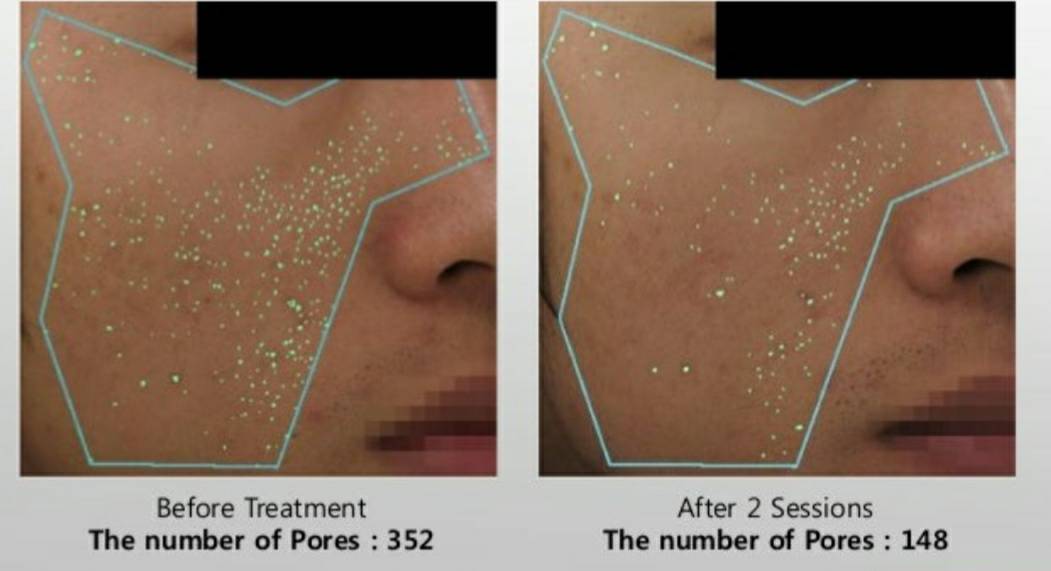
Enlarged pores, superficial texture, shallow Boxcar scars and deeper atrophic depressions may exist at different levels of the skin.
A deeper depression may require treatment at a deeper dermal plane, while texture and pore concerns may be treated more superficially.
Why does improvement continue after treatment?
Program INFINI is not a filler that mechanically raises the scar immediately. The procedure creates controlled thermal stimulation and initiates a healing process.
After healing begins, collagen and supporting dermal structures gradually rebuild and reorganize over the following weeks and months.
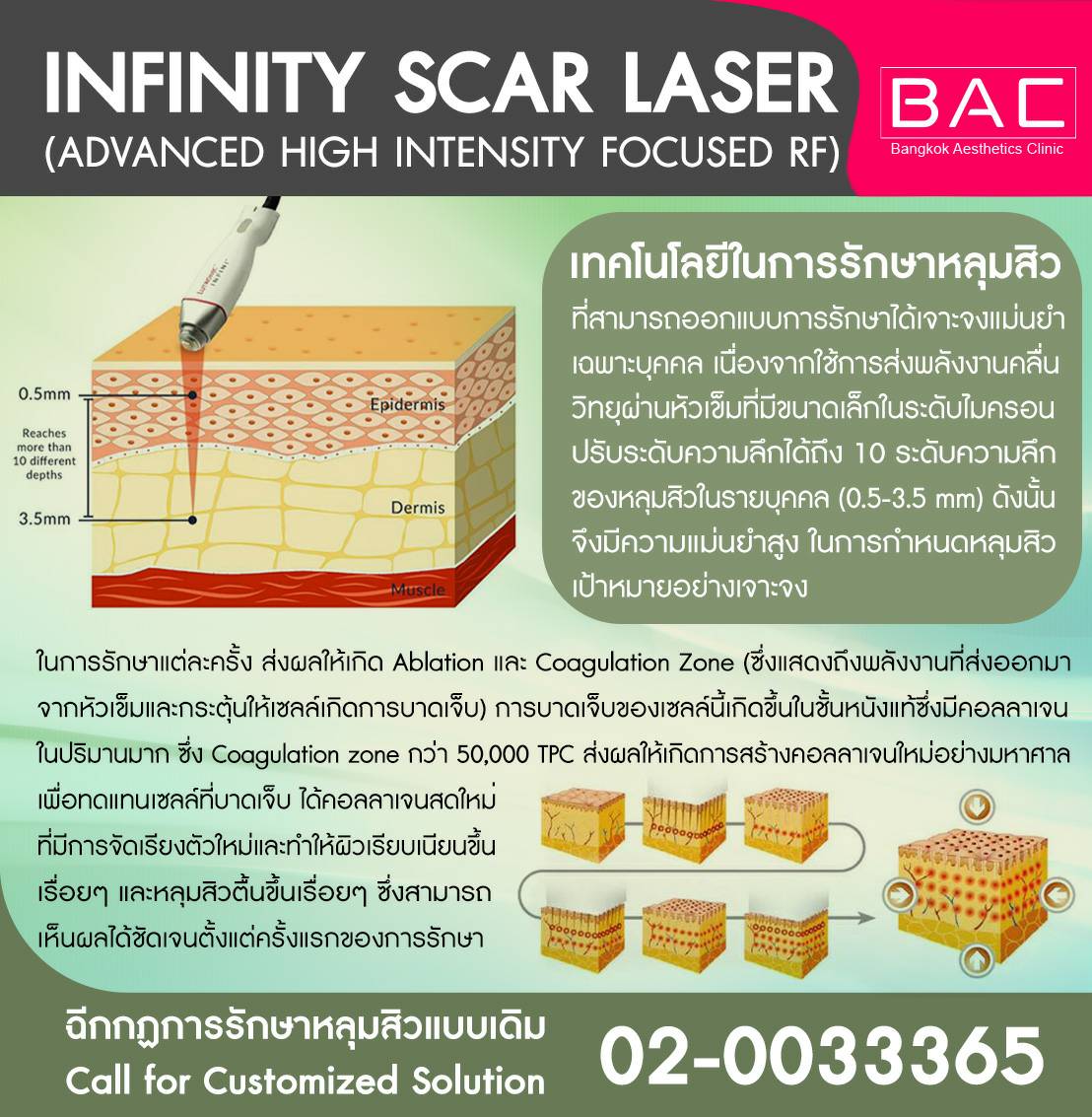
The words “RF Microneedling” do not tell you everything about how energy is delivered
RF Microneedling systems can differ in needle design, insulated versus non-insulated electrodes, treatment depth, electrode configuration, pulse duration and RF field geometry.
Two devices described with the same general treatment category may therefore create different patterns of RF energy within tissue.
If someone has previously undergone RF Microneedling with limited improvement, scar morphology, treatment depth and the presence of fibrous tethering should be reassessed.
Different electrode configurations can create different electrical pathways
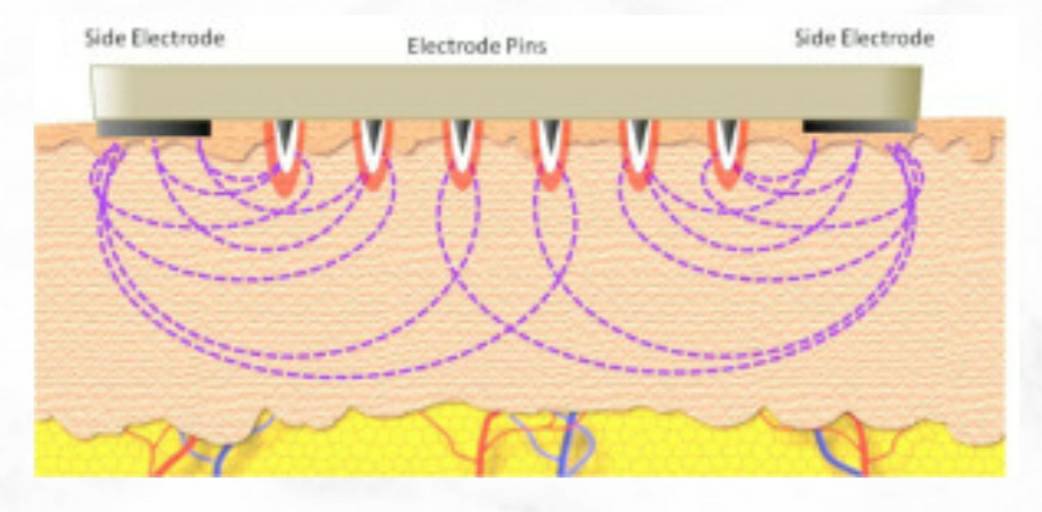
This archived educational diagram illustrates an alternative RF electrode configuration. Electrode architecture affects how electrical energy travels through tissue.
Deeper is not automatically better
Some aesthetic technologies are intentionally designed to reach deeper tissue planes. This can be appropriate when the target is laxity or deeper supporting tissue.
Acne scar revision is different. The goal is not to reach the deepest possible number. The goal is to place treatment at the tissue level involved in that particular scar.
Program INFINI may be considered when acne scars are part of a broader dermal texture problem
“I have already tried CO₂ or Fractional Laser.”
RF Microneedling may be considered when the treatment plan still requires dermal remodeling but a different energy-delivery pathway is preferred.
“I have both shallow and deeper scars.”
Adjustable treatment depth allows different areas to be approached according to scar depth and anatomy.
“I also have enlarged pores and uneven texture.”
As the dermis remodels, skin texture and the appearance of enlarged pores may improve in appropriate patients.
“I am concerned about post-inflammatory pigmentation.”
RF Microneedling has been studied across a range of skin types. Pigmentary changes can still occur, so treatment parameters, aftercare and sun protection remain important.
“My older scars look more obvious as my skin ages.”
A reduction in collagen, elasticity and tissue support can make existing depressions cast more visible shadows.
Selected treatment plans may therefore combine dermal remodeling with regenerative or structural support.
Do not judge collagen remodeling from the first few swollen days
Temporary swelling after treatment can make scars look shallower. A more meaningful assessment is made after early swelling resolves and the tissue has had time to remodel.
Atrophic acne scar improvement usually develops gradually, and many cases require more than one session or additional scar-specific techniques.
Program INFINI & Combination Acne Scar Revision
Swipe, use the arrows or allow the gallery to advance automatically.
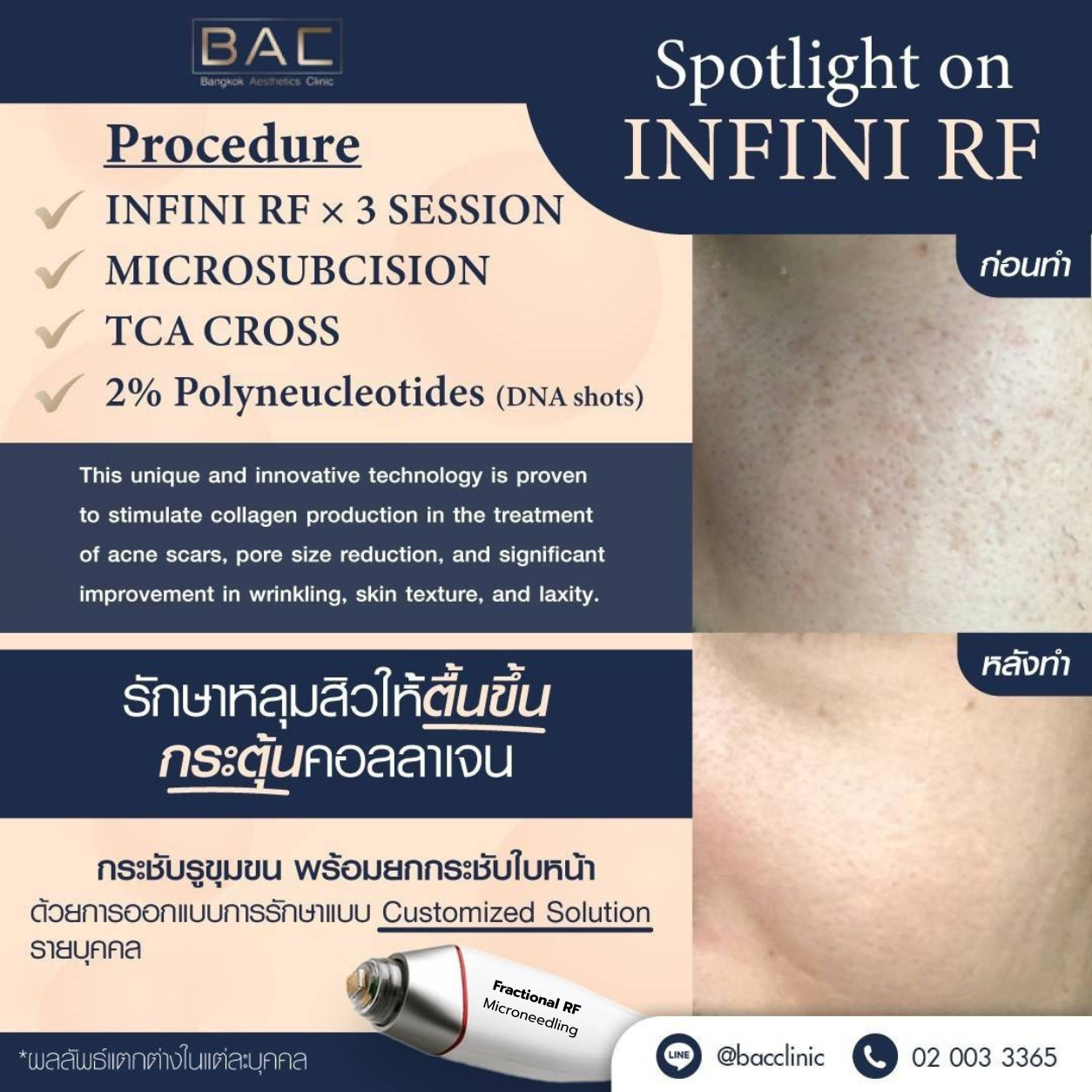
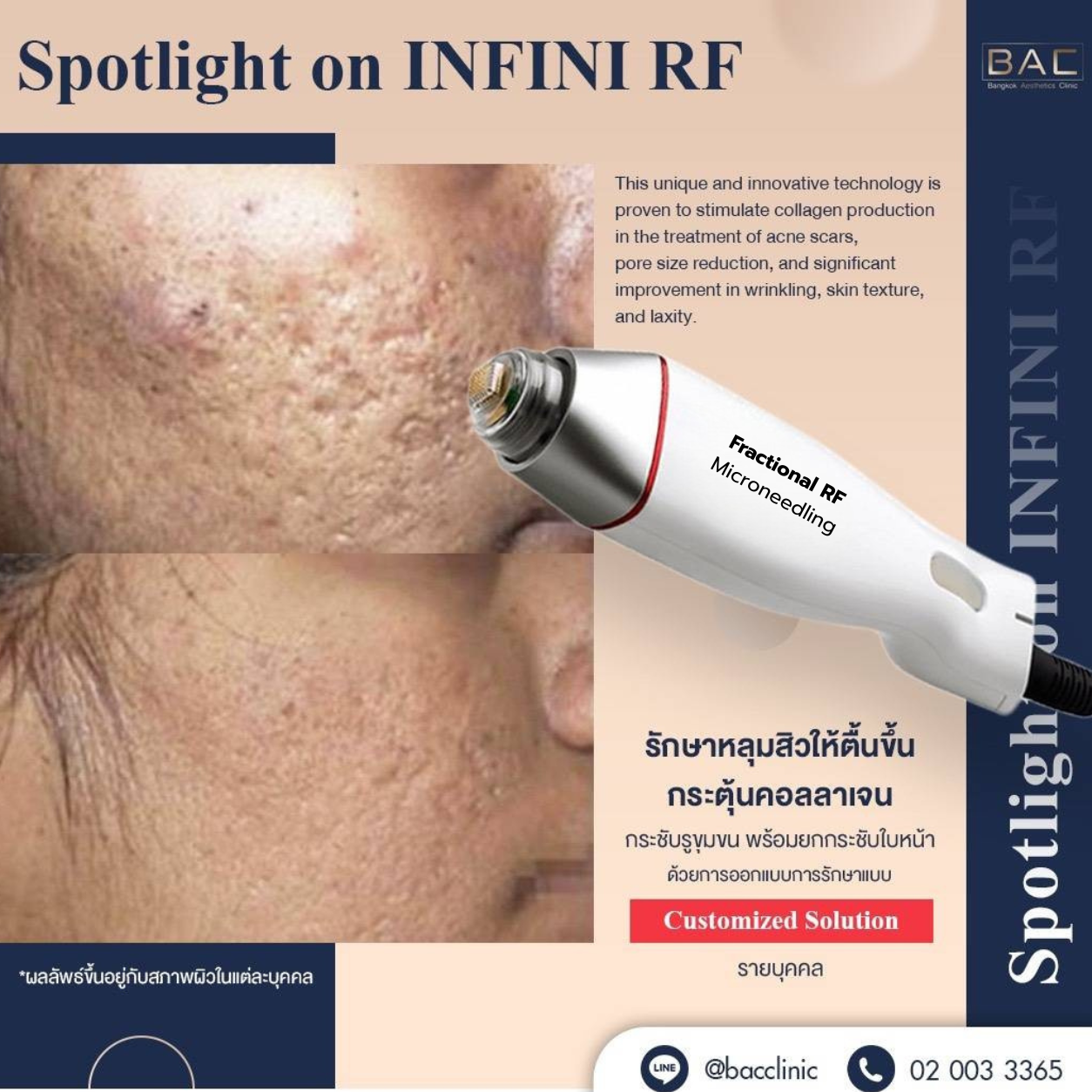
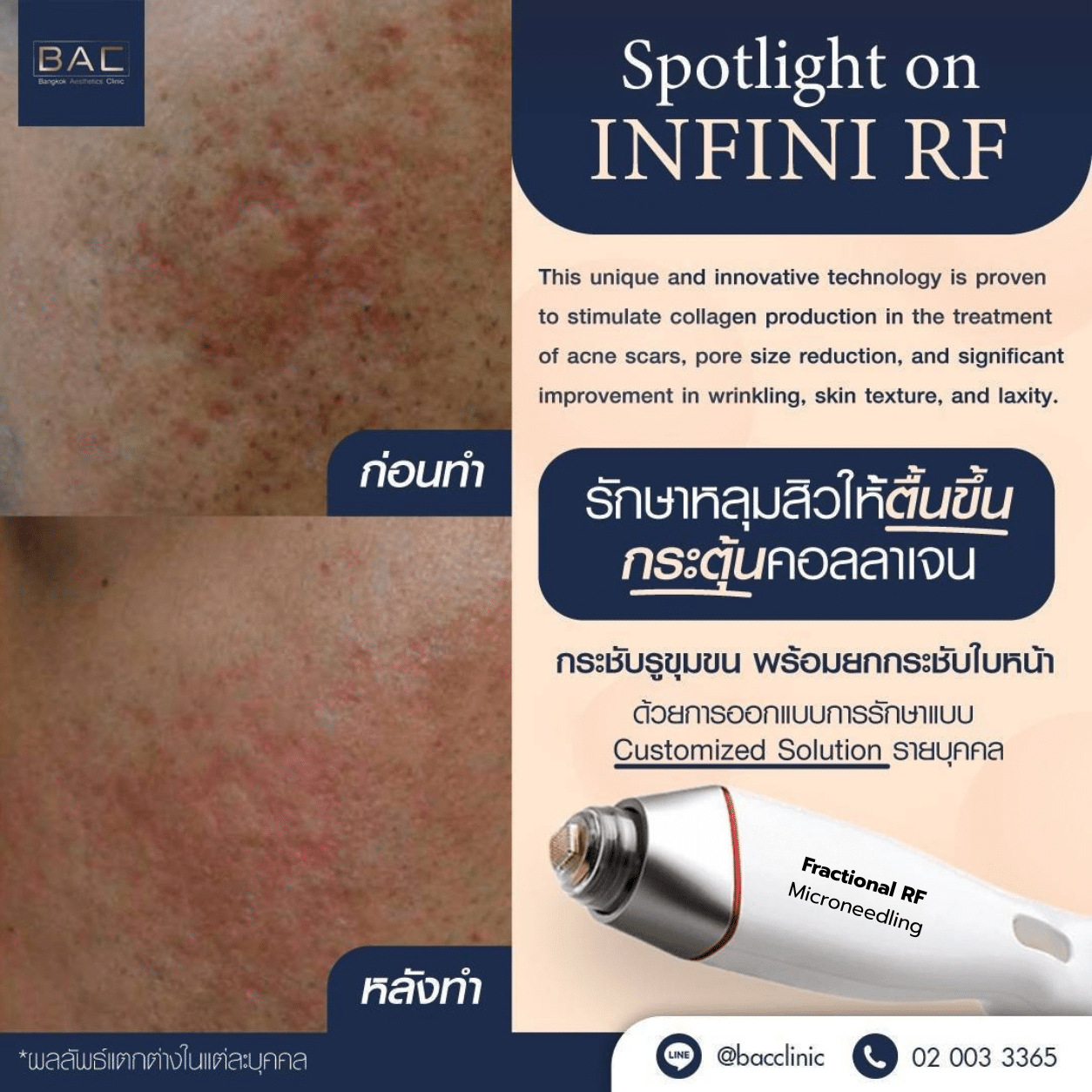
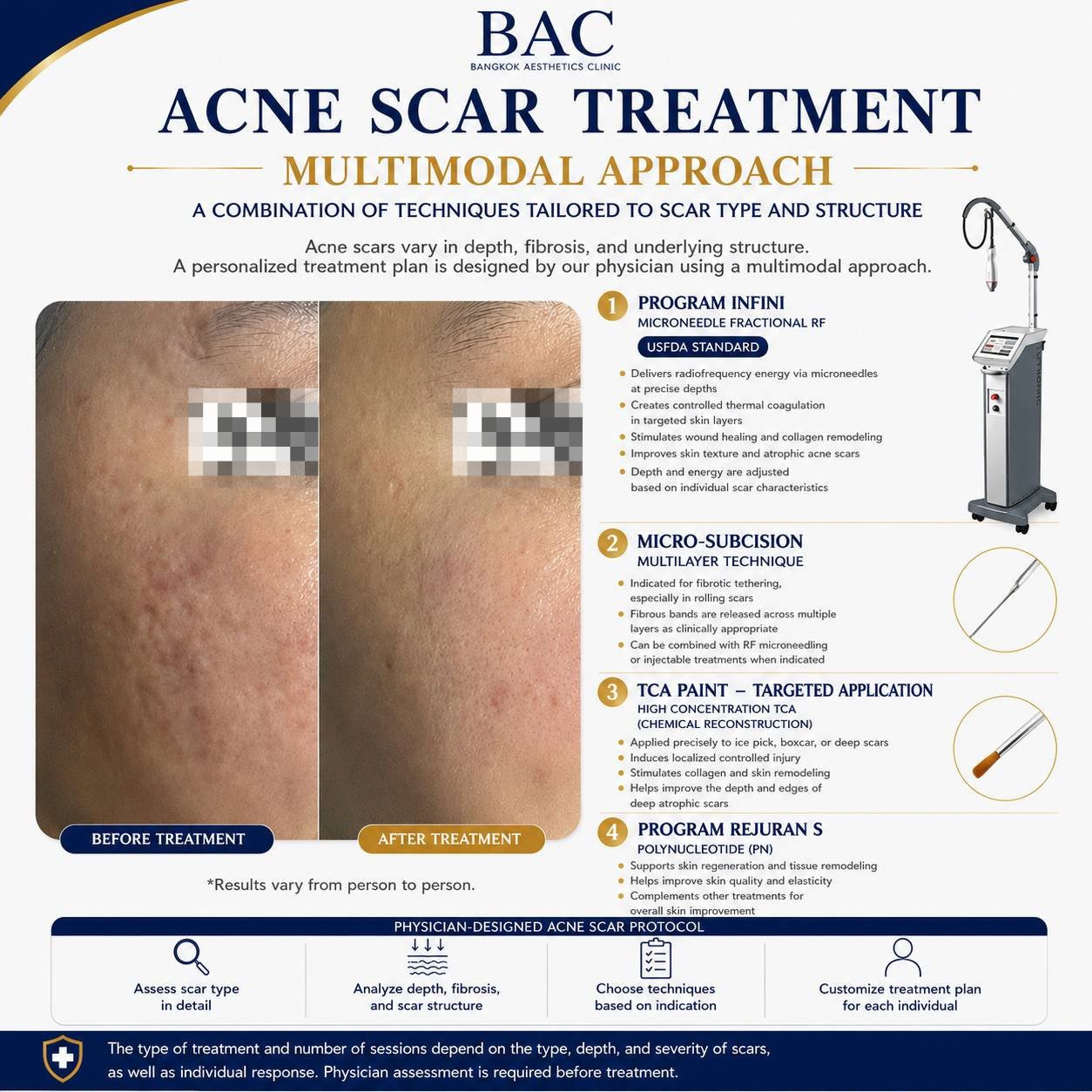
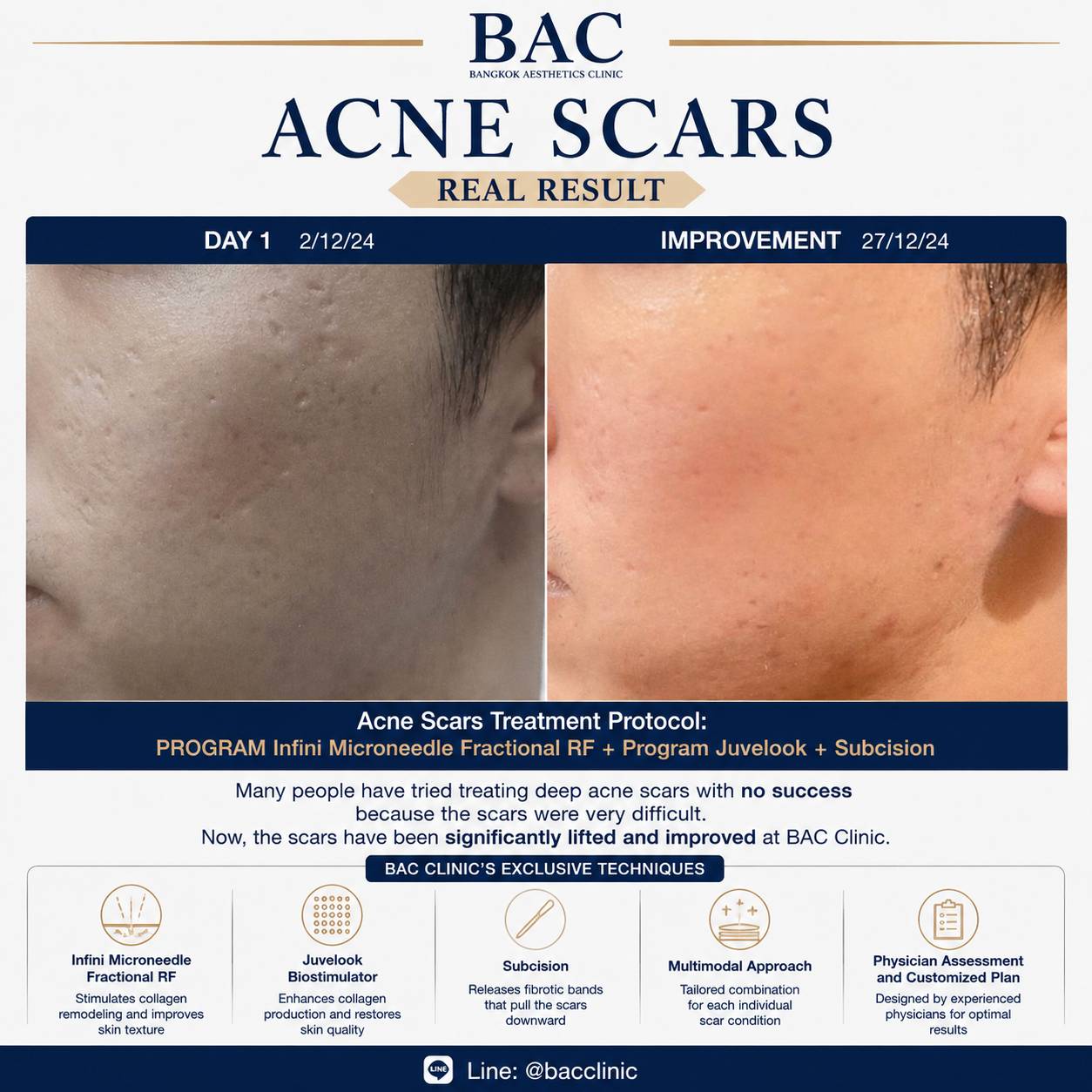
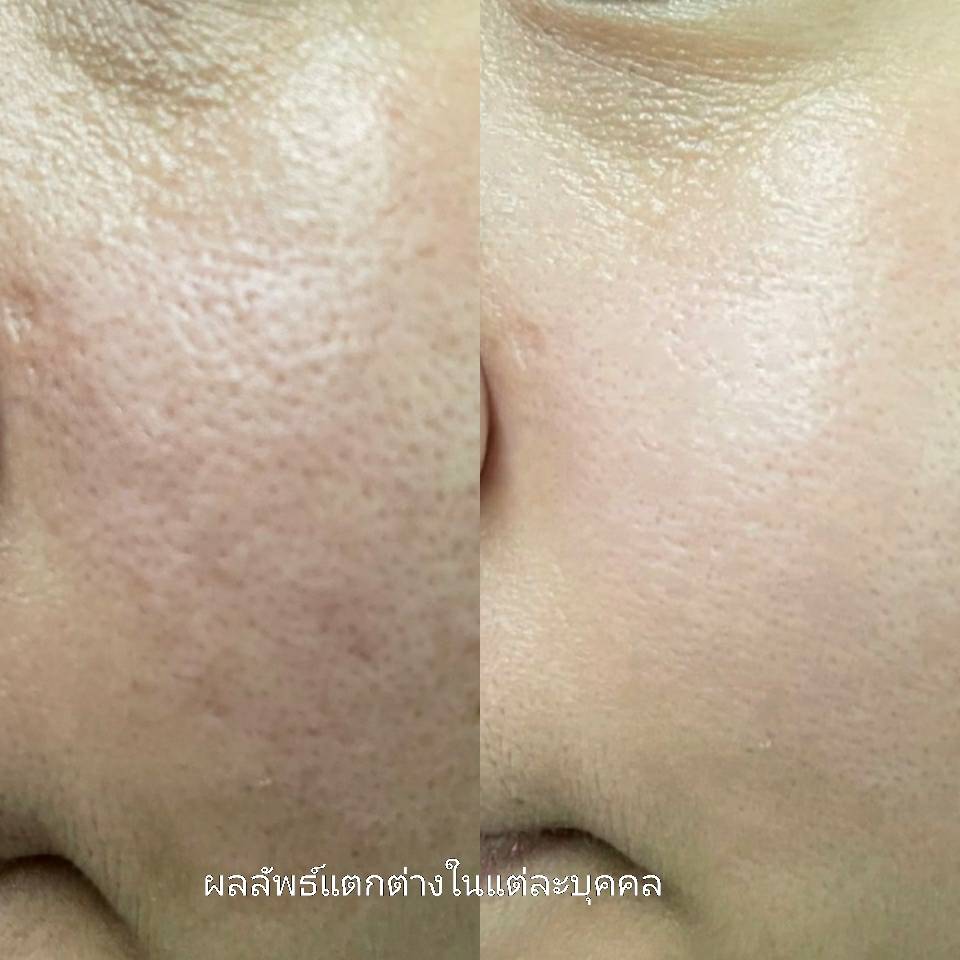
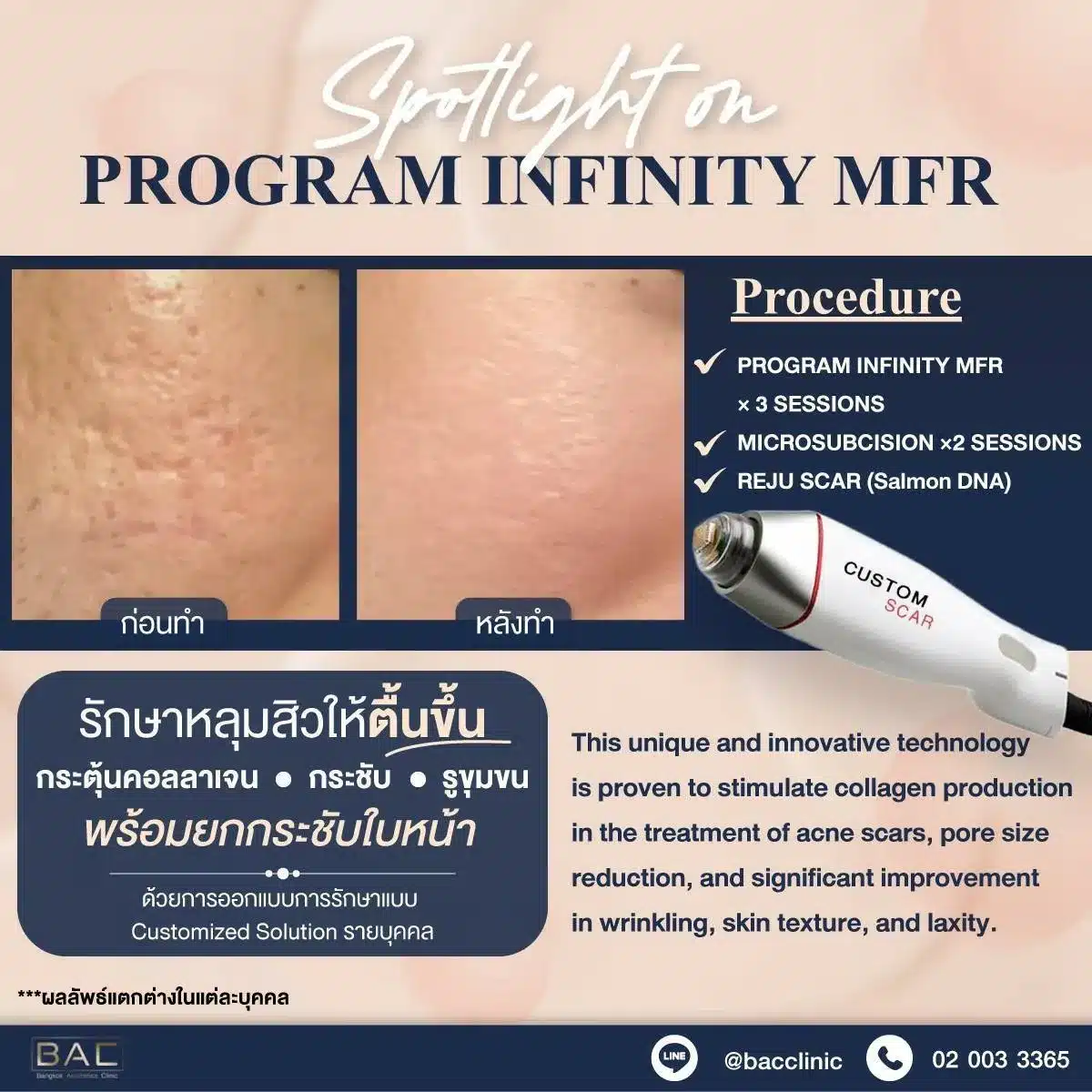

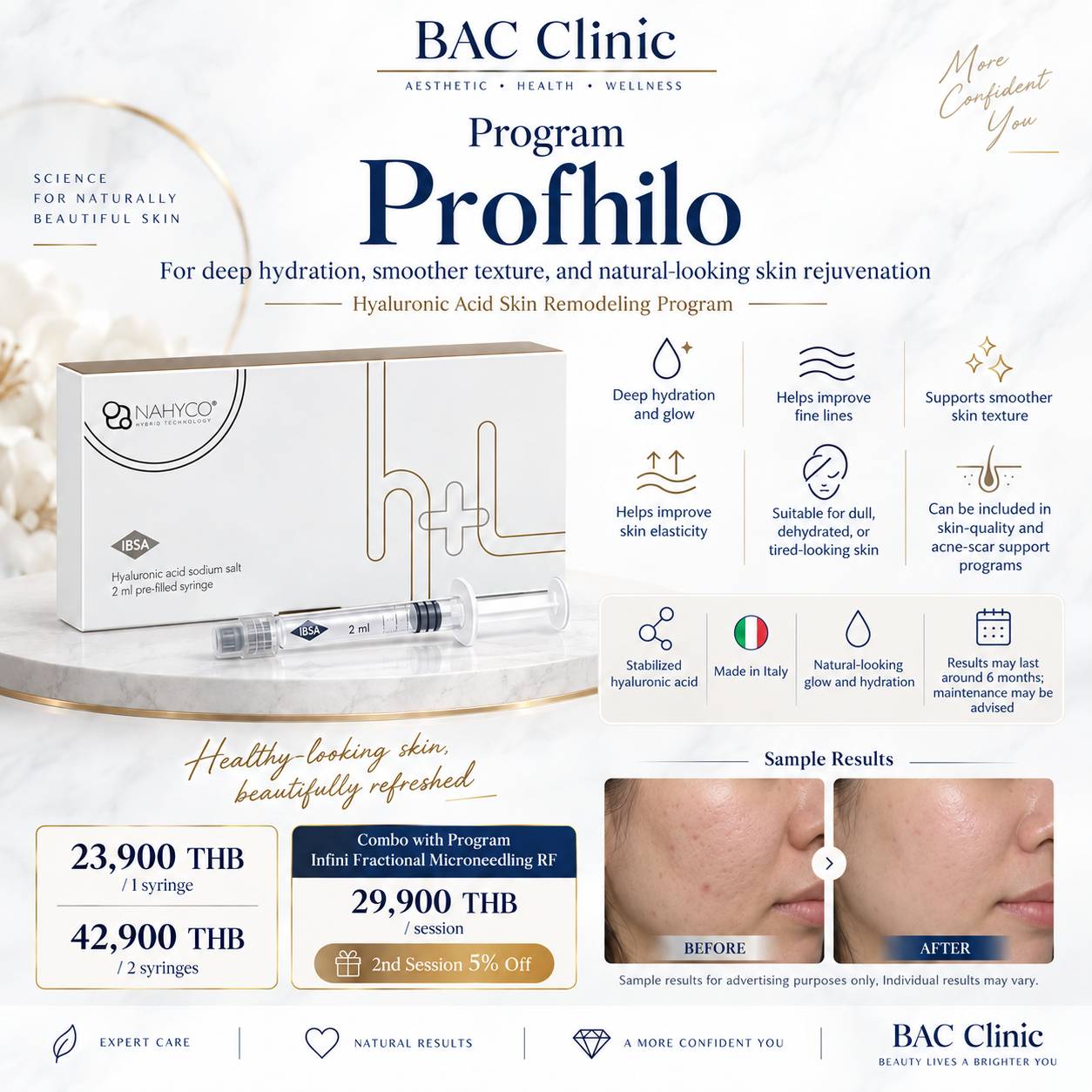
Individual results vary according to scar type, treatment plan and individual healing response.
Acne Scar Treatment — Before & After
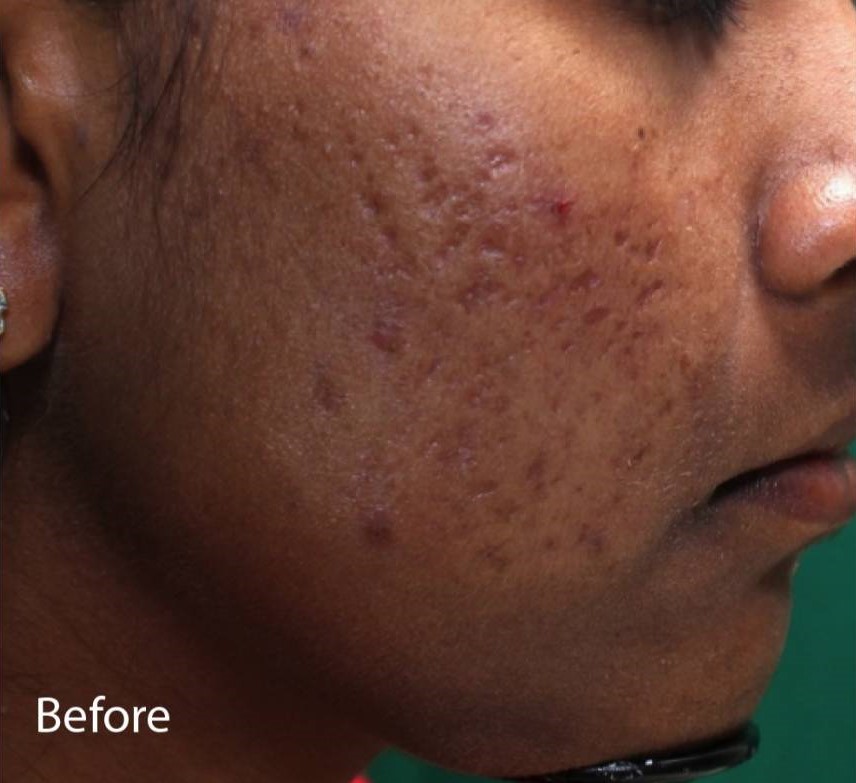 BEFORE
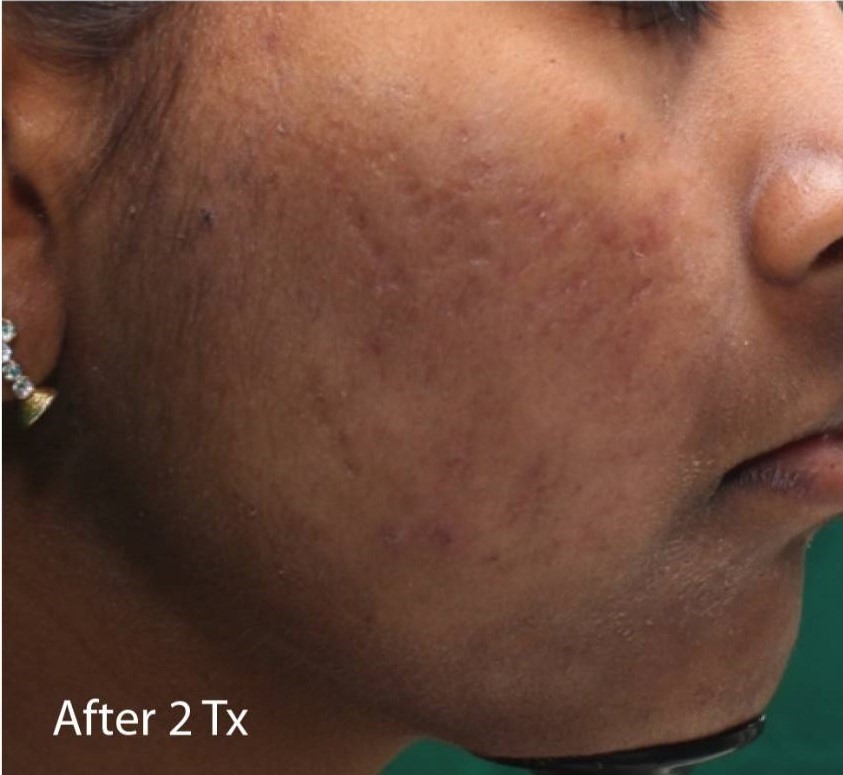 AFTER
AFTER
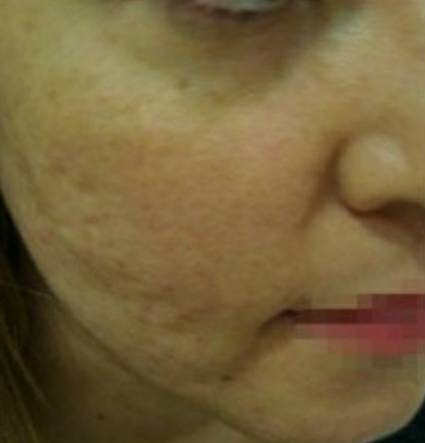 BEFORE
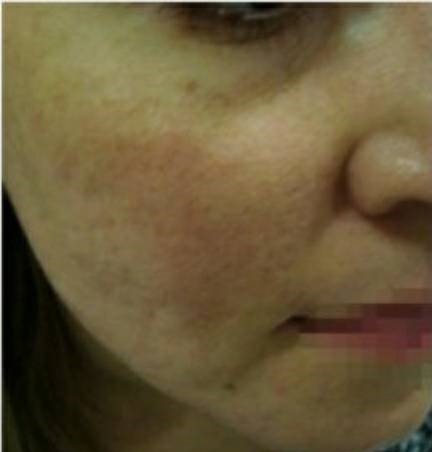 AFTER
AFTER
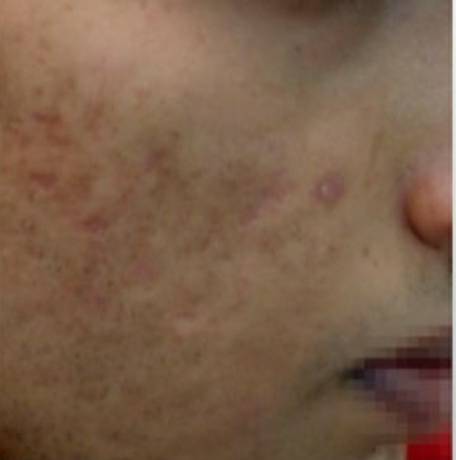 BEFORE
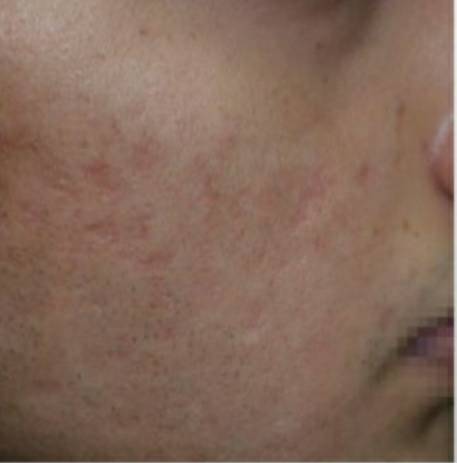 AFTER
AFTER
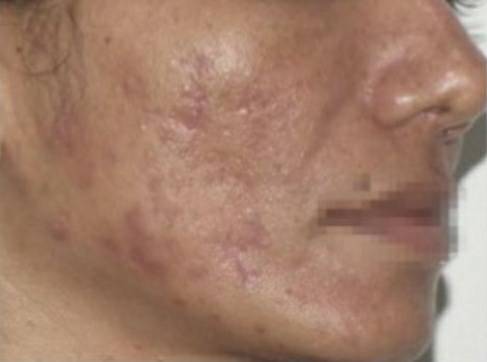 BEFORE
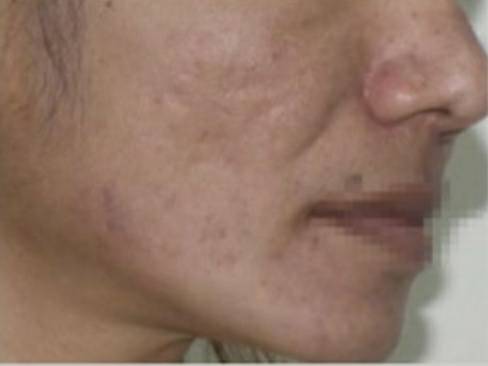 AFTER
AFTER
One patient may have Ice Pick, Boxcar and Rolling scars at the same time
Program INFINI does not need to perform every role in an acne scar plan.
Its major role is dermal remodeling. When another scar requires a mechanical or focal treatment, another technique can be selected for that particular problem.
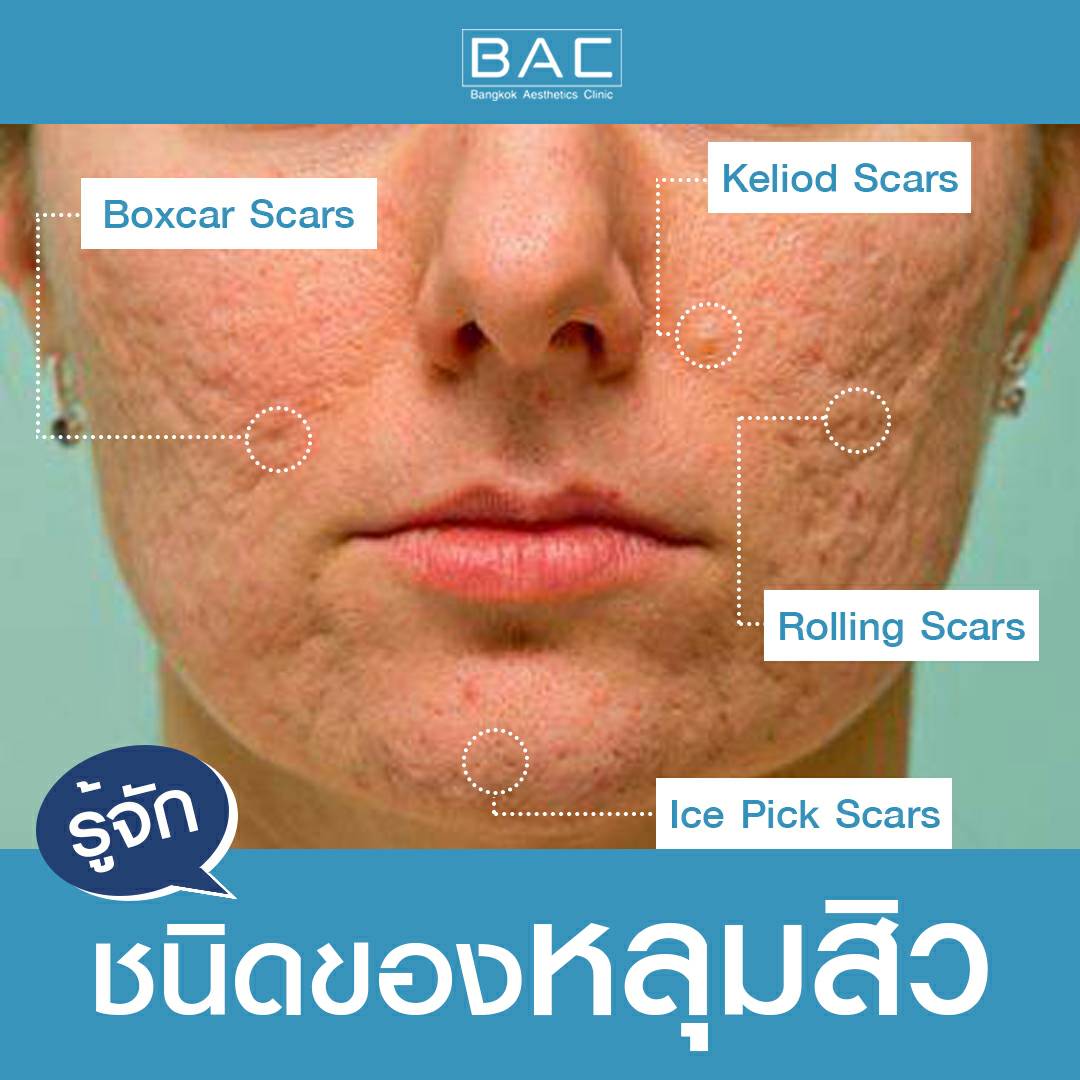
Narrow and Deep
Often appears as a small opening extending deeply into the skin. TCA CROSS is one focal option for appropriate Ice Pick scars.
Defined Edges
Boxcar scars may be shallow or deep. Depending on width, depth and tethering, treatment may include RF remodeling, TCA CROSS, Subcision or selected injectable support.
Broad, Wave-Like Depression
Rolling scars may be associated with fibrous tethering. When the scar base is anchored downward, Subcision may be considered before relying on collagen stimulation alone.
Program INFINI may be the core of dermal remodeling — but one treatment does not need to perform every role
Combination treatment should not mean adding as many procedures as possible. It should mean assigning a specific treatment to a specific structural problem.
Rejuran S, Juvelook and Rh Collagen should therefore not look like items automatically added to a package.
They are tools with different functions and should be selected only when the patient’s tissue requires that particular function.
Subcision + Program INFINI — release what is pulling the scar down, then remodel what needs to rebuild
Some Rolling scars are not caused by collagen loss alone. Fibrous bands may connect the scar base to deeper tissue and create persistent downward tension.
If that mechanical pull remains, repeated energy treatment can stimulate surrounding collagen without directly releasing the tethering itself.
Subcision is designed to release these fibrous attachments. BAC Clinic may use a blunt cannula, a Nokor-type technique or another approach according to scar anatomy.
Subcision and Program INFINI therefore perform different jobs: Subcision addresses the fibrous pull, while RF Microneedling supports dermal remodeling and collagen formation.
TCA CROSS + Program INFINI — when a focal scar requires more than general full-face remodeling
TCA CROSS stands for Chemical Reconstruction of Skin Scars. TCA is carefully applied within selected scars to create a controlled focal response.
It is commonly considered for suitable Ice Pick scars and selected narrow Boxcar scars.
Program INFINI may address broader dermal remodeling, while TCA CROSS is used selectively for scars requiring focal treatment.
Picosecond Laser can help pigment and texture — but deeper scars may still need structural treatment
Picosecond Laser can be useful for post-acne pigmentation, superficial texture and selected pore concerns, generally with relatively limited downtime.
A deep tethered scar is a different problem. Picosecond Laser does not mechanically release fibrous bands in the way Subcision does, and it does not create multi-depth RF coagulation in the same way as Program INFINI.
Program INFINI starts the signal — the tissue performs the remodeling afterward
The day of RF Microneedling is only the beginning of the biological process.
During the following weeks, the skin progresses through healing, rebuilding and reorganization of the supporting dermal structure.
Healing capacity differs between individuals, and one scar may have lost more supporting tissue than another.
This is where injectable treatments may sometimes play a supporting role. They do not replace Program INFINI. Instead, they may be selected when the scar base or surrounding tissue requires additional regenerative, collagen-stimulating or structural support.
Rejuran S + Program INFINI — when the healing phase may benefit from additional tissue support
Rejuran is an injectable treatment based on Polynucleotide or PN. PN treatments have been investigated in skin-quality and atrophic acne scar applications.
When Program INFINI creates controlled dermal stimulation, the skin then relies on its healing response to repair and reorganize tissue.
In selected cases, PN may be used as an adjunct to support tissue quality during this recovery process.
Rejuran S
Rejuran S may be considered as scar-focused PN support in selected areas, particularly after Subcision or alongside Program INFINI when the physician determines that the scar base or tissue quality would benefit from additional support.
When might Rejuran S be considered?
Examples may include scars that have already been released but still have a thin base, localized dermal atrophy, RF Microneedling cases requiring additional regenerative support, or plans addressing both scars and overall skin quality.
Rejuran S does not mechanically cut fibrous tethering and therefore does not replace Subcision when a Rolling Scar is clearly tethered.
Juvelook / PDLLA + Program INFINI — when selected scar areas may benefit from additional collagen stimulation
A biostimulator is an injectable treatment designed primarily to stimulate a tissue response associated with collagen formation rather than simply creating immediate gel volume.
PDLLA is one example. Published research has evaluated PDLLA in combination with Microneedle Fractional RF for atrophic acne scars.
At BAC Clinic, a biostimulator is considered an individualized adjunct, rather than a universal formula that every scar patient must receive.
Scar anatomy, treatment location and tissue plane should be considered before adding a biostimulator.
Rh Collagen / Atelocollagen + Program INFINI — when a selected scar base may need additional support
Atrophic acne scars involve loss of dermal matrix and supporting tissue.
In selected depressions, a collagen-based injectable may provide scaffold-like or structural support while the surrounding dermis continues remodeling.
A prospective study of heterologous Type I collagen injection in atrophic acne scars reported changes in scar grading and followed the study group for up to 12 months.
This does not mean every acne scar needs injectable collagen. Its role depends on scar morphology and the condition of the scar base.
| Treatment | Main Concept | Possible Role | Limitation |
|---|---|---|---|
| Rejuran S / PN | Regenerative tissue support | Selected scar bases and tissue-quality support | Does not release fibrous tethering |
| Juvelook / PDLLA | Collagen stimulation | Dermal support in selected areas | Requires appropriate placement and patient selection |
| Rh Collagen / Atelocollagen | Collagen-based structural support | Selected thin or depressed scar bases | Does not replace other scar-specific procedures |
| HA Filler | Volume replacement | Mechanical support for suitable depressions | Does not correct every scar architecture |
You do not have to decide between INFINI, Subcision, TCA CROSS, Rejuran S, Juvelook or Rh Collagen by yourself
The first step is to identify which scars are tethered, which are narrow and deep, which need broader dermal remodeling, and which scar bases may benefit from additional support.
Book a Free Doctor ConsultationProgram INFINI & Acne Scar Revision Prices
Treatment is selected according to scar morphology rather than requiring every patient to receive the same combination.
| Program | Price | Common Treatment Goal |
|---|---|---|
| Program INFINI Fractional Microneedle RF – Full Face | 9,900 THB | Acne scars, pores, texture and dermal remodeling |
| Program INFINI – 3 Sessions | 23,900 THB | Multi-session treatment plan |
| Program INFINI – 5 Sessions | 36,900 THB | Extended acne scar and texture program |
| Subcision Full Face | 2,900 THB | Rolling / tethered acne scars |
| Subcision Add-on with INFINI | 1,500 THB | Release + Remodel when appropriate |
| TCA CROSS | 500 THB / spot | Ice Pick / selected narrow Boxcar scars |
| TCA CROSS with Laser / RF | 1,200 THB | Multiple focal scars during combination treatment |
| TCA CROSS Standalone | 1,990 THB | Focal scar treatment |
| Rejuran S 1 cc | 9,900 THB | Scar-focused PN support |
| Rejuran S 1 cc + INFINI | 17,900 THB | RF remodeling + PN support |
| Juvelook PDLLA | 14,900 THB / vial | Biostimulator / collagen stimulation |
| Juvelook – 2 Vials | 28,900 THB | Selected-area collagen stimulation |
| Juvelook – 3 Vials | 39,900 THB | Extended plan according to assessment |
| Rh Collagen / Atelo-rh Collagen | 22,900 THB / syringe | Collagen-based structural support |
| Rh Collagen – 2 Syringes | 43,900 THB | Structural support across selected areas |
Prices and promotional packages may change. Treatment suitability, amount and combination procedures are determined after assessment.
What happens after Program INFINI?
Redness and swelling vary according to treatment depth, energy, number of passes and whether another procedure is performed during the same visit.
Follow the clinic’s cleansing and post-treatment instructions.
Use gentle skincare and avoid unnecessary irritation while the treatment points settle.
Avoid unnecessary heat, excessive sun exposure and irritating skincare actives until the skin has recovered.
Sunscreen and Hydration
Use a gentle moisturizer and broad-spectrum sunscreen. Consistent sun protection is particularly important for patients prone to post-inflammatory pigmentation.
Temporary Roughness or Microcrusting
Tiny treatment points may create temporary roughness or fine microcrusting. Recovery varies according to treatment intensity.
Treatment Spacing
Session intervals are individualized according to skin recovery, treatment intensity and combination procedures.
We do not design an acne scar plan around one machine
Treatment planning begins with scar morphology, depth, tethering, scar base, pigmentation, skin type and acceptable downtime.
A patient with tethered Rolling scars may need Subcision. A narrow Ice Pick scar may need TCA CROSS. Broader dermal atrophy and texture may benefit from RF remodeling. Selected thin scar bases may benefit from additional support.
This is the BAC Clinic approach to customized Acne Scar Revision: identify the structural problem first, then select each treatment according to the role it needs to perform.
Different energy pathways, different treatment characteristics
Both Fractional CO₂ Laser and Fractional RF Microneedling have published evidence for atrophic acne scars.
Comparative studies have reported improvement with both modalities, while differences may exist in recovery profile and pigmentary response depending on treatment parameters and patient population.
The practical question is therefore not “Which technology is universally better?” but which tissue target, recovery profile and treatment pathway fit the individual scar pattern.
Acne Scar Revision FAQ
Can acne scars really improve?
Many atrophic acne scars can improve, but the degree of change varies according to scar type, depth, tethering, skin characteristics and treatment plan. Complete removal cannot be guaranteed.
Why can Rolling scars remain after repeated laser treatments?
Some Rolling scars are mechanically tethered by fibrous bands. Energy treatment may stimulate collagen without releasing this downward pull. Subcision may therefore be considered when tethering is present.
How many microneedles does INFINI use?
INFINI uses a 7 × 7 array containing 49 microneedle electrodes, with adjustable treatment depth up to approximately 3.5 mm.
What types of acne scars are commonly considered for TCA CROSS?
TCA CROSS is commonly considered for appropriate Ice Pick scars and selected narrow Boxcar scars. It is a focal scar technique rather than a full-face chemical peel.
What is the role of Rejuran S?
Rejuran S may be considered as PN-oriented support for selected scar bases and tissue quality. It does not mechanically release fibrous tethering.
How is Rejuran S different from Juvelook?
Rejuran S belongs to the Polynucleotide-oriented regenerative injectable category, while Juvelook contains PDLLA and is used as a biostimulator associated with collagen stimulation.
What is the role of Rh Collagen?
In selected scar bases, collagen-based injectable material may be considered for structural or scaffold-like support.
Can Subcision, Program INFINI and Rejuran S be performed during one visit?
Combination treatment may be appropriate for selected patients. Treatment area, scar severity, expected swelling and physician assessment determine whether procedures are combined or staged.
How many Program INFINI sessions may be needed?
Acne scar treatment commonly requires a series rather than a single session. The actual number depends on scar severity, treatment intensity and whether other scar-specific procedures are added.
Is Picosecond Laser enough for deep acne scars?
Picosecond Laser may help pigmentation and superficial texture, but it does not replace Subcision for clear fibrous tethering or focal CROSS treatment for appropriate deep scars.
Selected Evidence Behind the Treatment Concepts
- U.S. FDA 510(k) Premarket Notification: INFINI Radiofrequency System, K121481. FDA Database
- Polynucleotide in moderate-to-severe acne scar treatment. PMID: 33755110. PubMed
- Poly-D,L-lactic acid with Microneedle Fractional Radiofrequency for acne scars. PMID: 36449872. PubMed
- Heterologous Type I Collagen injection for atrophic acne scars. PMID: 40771444. PubMed
- Fractional CO₂ Laser versus Fractional Microneedling RF for acne scars. PMID: 34566360. PubMed
- Radiofrequency and RF Microneedling in skin of color. PMID: 36826381. PubMed
The most appropriate treatment is not automatically the strongest or the deepest. It is the treatment used at the right layer for the right scar.
Program INFINI Fractional Microneedle RF is used as a major dermal-remodeling tool at BAC Clinic.
When another structural problem is present, another technique may be added for that specific role: Subcision for fibrous tethering, TCA CROSS for selected narrow deep scars, Rejuran S for PN-oriented support, Juvelook for biostimulation and Rh Collagen for selected collagen-based structural support.
BAC Clinic – Bangkok Aesthetic Clinic
Sukhumvit 16, Bangkok, Thailand
Doctor consultation is complimentary.
Continue Exploring Acne Scar Revision
Learn more about scar anatomy, fibrous tethering and focal treatment for deep acne scars.
Understanding Acne Scar Treatment
Explore the original BAC Clinic educational page on scar structure, RF technology and acne scar treatment.
Read More → 02 • SUBCISIONSubcision for Tethered Acne Scars
Learn why Rolling scars and selected depressions may need fibrous release before or alongside collagen remodeling.
Read the Subcision Guide → 03 • TCA CROSSTCA CROSS for Ice Pick & Narrow Deep Scars
Understand how focal TCA treatment may be used for selected narrow and deep atrophic scars.
Read About TCA CROSS →