
Understanding Scar Edges, Collagen Loss and Modern Acne Scar Revision
One of the most common frustrations among acne scar patients is this:
“I’ve already had laser treatments, but my scars still look obvious.”
In many cases, the problem is not that the treatment failed.
The problem is that acne scars are more complex than most people realize.
At BAC Clinic Bangkok Acne Scar Revision Center, one of the most common scar types we see is the boxcar scar.
While many people assume these scars are simply “holes in the skin,” the reality is far more complicated.

Modern acne scar revision has shown that the visibility of a boxcar scar is influenced by several different factors:
- Scar depth
- Scar edge definition
- Collagen loss
- Skin thickness
- Tissue remodeling
- Fibrotic attachments
This explains why two patients with scars of similar depth can appear dramatically different.
Sometimes the issue is not how deep the scar is.
Sometimes the issue is how sharply the scar reflects light.
What Exactly Is a Boxcar Scar?
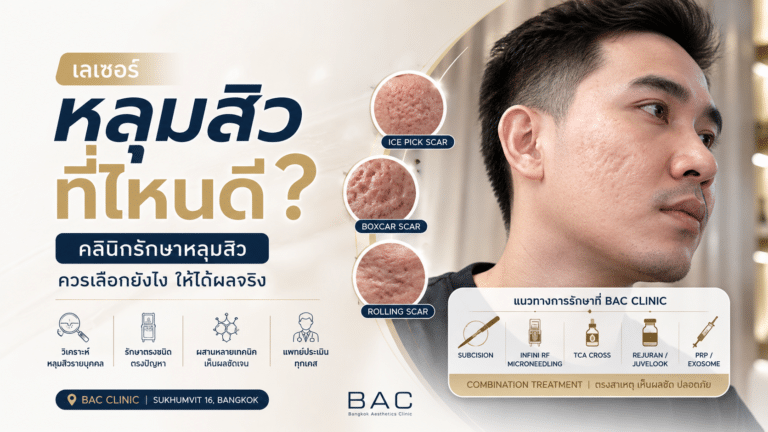
A boxcar scar is a type of atrophic acne scar characterized by:
- Round or oval depressions
- Clearly defined edges
- Abrupt transition between normal skin and scar tissue
- Variable depth
Unlike rolling scars, which have sloping borders, boxcar scars often have sharp edges.
These sharp edges are important.
Because when light strikes the skin, those edges create shadows.
The sharper the edge, the more visible the scar appears.
This is one reason patients often notice their scars more under:
- Sunlight
- Bathroom lighting
- Camera flash
- Side lighting
Interestingly, a scar does not necessarily have to be deep to appear noticeable.
A shallow scar with a sharp edge may sometimes appear more obvious than a deeper scar with softer borders.

Why Some Boxcar Scars Still Look Visible After Laser Treatment
Many patients are surprised when they undergo several laser sessions yet still feel disappointed.
The reason is that laser treatment may improve one aspect of a scar while leaving another relatively unchanged.
For example:
A treatment may stimulate collagen production.
However, if the scar edge remains sharply defined, the scar may continue casting shadows.
This creates the impression that little improvement has occurred, even though collagen remodeling is taking place beneath the surface.
This phenomenon explains why experienced acne scar specialists evaluate more than scar depth alone.
We also evaluate:
- Scar edge quality
- Scar transition zones
- Surface texture
- Light reflection patterns
The Four Components of Modern Boxcar Scar Treatment
Modern acne scar revision increasingly focuses on four separate treatment goals.

1. Softening the Scar Edge
One of the most overlooked aspects of acne scar treatment is scar edge softening.
When the transition between normal skin and scar tissue becomes smoother, the scar becomes less visible.
This is often true even before significant volume improvement occurs.
Procedures that may contribute to scar edge softening include:
- Picosecond Laser
- Fractional Laser
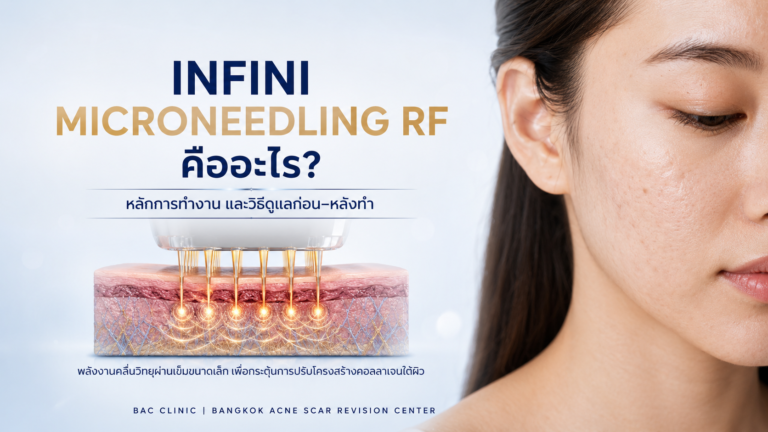
- RF Microneedling
These treatments help remodel collagen near the scar border and improve the transition between normal skin and scar tissue.
The result is often a scar that reflects light more naturally.
Patients frequently describe this as:
“My skin looks smoother.”
Even when the scar itself has not completely disappeared.
2. Increasing Dermal Thickness
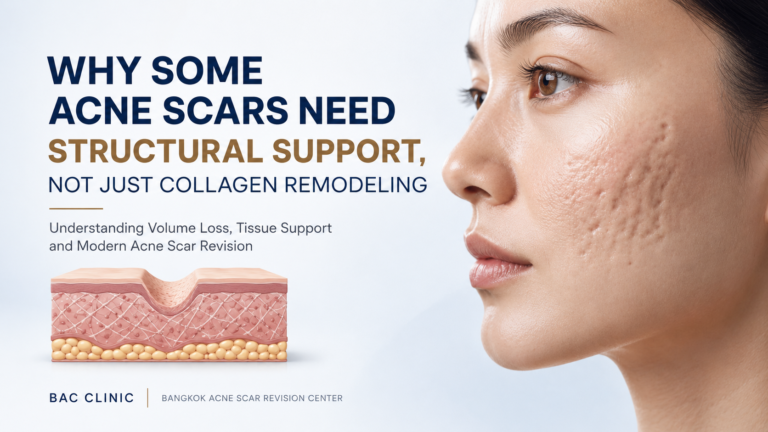
Many boxcar scars are associated with thinning of the dermis.
The skin becomes less capable of supporting itself.
As a result, depressions become more noticeable.
Treatments that stimulate collagen production may help increase dermal thickness over time.
Examples include:
- Infini RF Microneedling
- RF Microneedling
- Biostimulators
The goal is not simply to fill the scar.
The goal is to strengthen the skin structure surrounding it.
3. Rebuilding the Scar Base
Some boxcar scars contain significant tissue loss.
In these cases, collagen stimulation alone may not be sufficient.
The scar base itself may require reconstruction.
Procedures commonly used include:
- TCA CROSS
- Polynucleotides
- Biostimulators
Patients researching Acne Scar Treatment Bangkok often assume TCA CROSS is only useful for ice pick scars.
In reality, certain deep boxcar scars may also benefit from targeted reconstruction of the scar base.
4. Releasing Hidden Scar Attachments
Although rolling scars are most commonly associated with tethering, some boxcar scars may also contain fibrotic attachments.
When this occurs, collagen stimulation alone may not fully correct the depression.
In selected cases, Subcision may be incorporated into the treatment plan.
This allows scar tension to be released before collagen remodeling procedures are performed.
Why Combination Therapy Often Produces Better Results
One of the biggest mistakes in acne scar treatment is searching for a single “best treatment.”
No treatment addresses every aspect of a scar.
For example:
Picosecond Laser may improve scar edge quality.
RF Microneedling may stimulate collagen remodeling.
TCA CROSS may rebuild deeper scar bases.
Subcision may release tethering.
Each treatment solves a different problem.
This is why combination therapy has become the foundation of modern acne scar revision.
Instead of treating the scar as one problem, specialists treat the individual components contributing to its appearance.
Final Thoughts
Perhaps the most important thing patients should understand is that a visible scar is not simply a hole in the skin.
A scar is a combination of:
- Shadow
- Edge definition
- Tissue loss
- Collagen deficiency
- Surface texture
- Structural support
Modern acne scar treatment therefore focuses on much more than simply filling depressions.
The goal is to create skin that reflects light more naturally, transitions more smoothly, and appears more even overall.
For this reason, the most successful acne scar treatment plans often combine multiple technologies, each targeting a different component of scar formation.
When viewed this way, acne scar revision becomes less about finding a miracle treatment and more about understanding what is actually making the scar visible in the first place.