
Introduction
Having smooth, even skin is a goal many of us share. Yet for individuals who have suffered moderate to severe acne, the aftermath often includes atrophic “pitted” scars — commonly known as acne scars — that can significantly impact confidence and perception of one’s appearance. At BAC Clinic in Bangkok, one of the most effective and well-documented methods we offer for treating certain types of post-acne scarring is the TCA CROSS technique (Trichloroacetic Acid Chemical Reconstruction Of Skin Scars). This article takes a comprehensive clinical-style overview of TCA CROSS as applied at BAC Clinic: the rationale, mechanism, treatment process, patient selection, expected outcomes, aftercare, risks/mitigation, and how the clinic’s protocol is tailored for optimal results.
1. Understanding the Problem: Atrophic Acne Scars
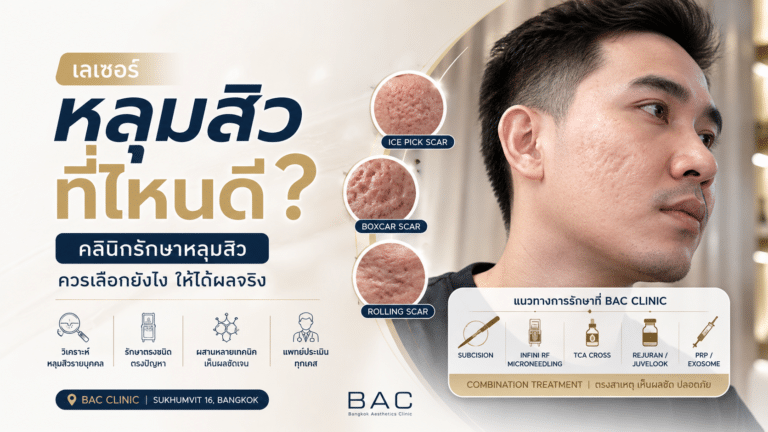
Acne scarring arises when deep inflammatory lesions damage the dermal structure and the normal healing mechanism fails to fully restore volume and architecture. Atrophic scars are the most common type of acne scars and can be further subclassified into:
- Icepick scars: narrow (< 2 mm), deep, V-shaped depressions penetrating into the dermis or even subcutaneous tissue.
- Boxcar scars: broader U- or V-shaped depressions with defined edges; can be shallow or deep.
- Rolling scars: wave-like depressions with sloping edges caused by dermal tethering.
The type of scar strongly influences which treatment modality will be most effective. Research confirms that while lasers, subcision, microneedling and fillers each have roles, some scars—especially deep icepick scars—remain difficult to treat. PMC+1
At BAC Clinic we begin by mapping scars by subtype, depth, size, skin type (Fitzpatrick I-VI) and patient goals. For patients whose predominant issue is icepick or narrow boxcar scars, especially where deeper dermal collagen loss is present, TCA CROSS is often an excellent option.
2. What Is TCA CROSS and Why Use It?
TCA CROSS stands for Chemical Reconstruction of Skin Scars using high-concentration trichloroacetic acid (TCA) applied focally (‘dot’ technique) to the base of individual atrophic acne scar pits. The process stimulates a controlled injury in the scar pit, triggering dermal remodeling with new collagen formation, thickening of the dermis, and gradual elevation of the depressed area. Lippincott Journals+1
Advantages of TCA CROSS:
- Highly targeted: only the scar pit itself is treated, minimizing damage to surrounding normal tissue. PMC+1
- Effective for deep narrow scars (icepick) which often respond poorly to other treatments. In a serial pilot study, > 70% improvement was seen in eight of ten patients with 100 % TCA CROSS. PMC
- Cost-effective relative to ablative lasers or full-face deep peels.
- Can be combined with other modalities (subcision, microneedling, laser) to address complex or mixed-type scarring. Lippincott Journals

Why it works:
- A high-concentration TCA ‘dot’ is applied to the scar base until frosting occurs (protein coagulation). The local injury triggers a wound-healing cascade.
- Dermal fibroblasts respond, new collagen, elastin and glycosaminoglycan (GAG) are synthesized, raising the level of the scar floor and improving skin texture. Lippincott Journals+1
- Because the surrounding normal tissue is spared, healing is faster and the risk of broad side-effects is less than full-face deep chemical peels.
3. Patient Selection: Who Is a Good Candidate?
At BAC Clinic we evaluate the following factors before recommending TCA CROSS:
Good candidates:
- Predominant icepick scars (narrow, deep, V-shaped) or narrow boxcar scars where other modalities have limited effect.
- Skin that is otherwise in good condition (no active acne inflammation, no recent isotretinoin use, stable skin health).
- Skin type: All Fitzpatrick types can undergo TCA CROSS, but in darker phototypes (IV-VI) extra caution is needed for post-inflammatory hyperpigmentation (PIH). Lippincott Journals+1
- Patients who understand the downtime, the need for aftercare, and have realistic expectations.
Less ideal candidates / caution required:
- Rolling scars that are broad and tethered: these respond better to subcision or laser rather than TCA alone. Lippincott Journals+1
- Active acne or infection: requires control before scar treatment.
- Recent isotretinoin (depending on clinic protocol).
- Patients unwilling or unable to adhere to post-treatment care, sun avoidance and follow-up.
- Patients with a history of poor wound healing, keloids, uncontrolled pigmentation disorders.
At BAC Clinic, we perform a baseline assessment including scar mapping, photographs, scalpel skin‐stretch test, depth estimation, and we often combine modalities if the scar pattern is complex.
4. Protocol at BAC Clinic for TCA CROSS
Here’s a typical treatment flow at our clinic (subject to individual tailoring):
Pre-treatment preparation
- Consultation & assessment: Medical history, skin type, scar classification, expectations.
- Priming: For patients with darker skin or history of PIH we may start topical retinoids, hydroquinone or other pigment-modulating agents 2–4 weeks in advance.
- Photography: Standardised before-images for comparison.
- Consent: Discussion of downtime, risks, number of sessions required (often 3–5 sessions at 2–4-week intervals).
During treatment
- Face is cleansed and degreased (often acetone wipe) to ensure optimal acid penetration.
- Scar pits are individually and focally treated: a fine applicator (wooden tooth-pick, 30-gauge needle, or similar) is used to apply high-concentration TCA (e.g., 50 %-100%) into the base of each scar until frosting is achieved. PMC+1
- Surrounding skin is protected; care is taken to avoid spilling acid into normal tissue. A recent case emphasised that imprecise application may worsen the scar due to collateral injury. PMC
- The patient experiences a brief sting or tingling; no general anaesthesia is required.
- Typically the session lasts 5–30 minutes depending on scar number and distribution.
After treatment
- Immediately after: mild crusting/frosting visible on treated pits.
- Crusts will form within 1–2 days, remain for ~3–7 days and generally fall off by day 7–10. Lippincott Journals+1
- Advise gentle cleansing, non-comedogenic moisturiser, strict sun protection (SPF 30+ broad-spectrum), avoidance of picking/peeling.
- Subsequent sessions are typically spaced 2–4 weeks apart; for many patients 3–5 treatments yield optimal results.
- Full clinical result becomes evident in ~3–4 months as new collagen remodels. Some improvement is seen by 4-6 weeks. Lippincott Journals+1
At BAC Clinic specifically
- Pricing for TCA CROSS: Points are that if done with a laser (e.g., Pico or Infini MFR) then cost is 500 ฿ per spot or 1,200 ฿ full face; if without laser coupling: 800 ฿ per spot or 1,990 ฿ full face.
- The clinic emphasises combined modality when required (TCA CROSS + Pico Laser / Infini) to maximise outcome for mixed scar types.
- Post-treatment follow-up is provided: check at day 7–10 (crust shed), 4-6 weeks (early collagen remodelling), and at ~3-4 months (final result).
- Documentation of results and patient-satisfaction monitoring is part of quality control.
5. Clinical Evidence: What Do Studies Say?
There is robust, though not unlimited, clinical literature supporting TCA CROSS in acne scar management:
- A pilot study with 12 patients treated with 100 % TCA CROSS for icepick scars showed > 70% improvement in 8/10 evaluated subjects, with minimal side-effects (transient hypo/hyper-pigmentation in one each). PMC
- Another study comparing 50% versus 80% TCA in 31 patients found both concentrations significantly improved ECCA scoring; although 80% had slightly better effect, complications were higher. PubMed
- A systematic review of non-energy modalities notes that for TCA CROSS: “Patients may expect a 1–2 grade improvement in their acne scars over a 6-month period.” DermNet®
- In combination therapies (e.g., subcision + TCA CROSS + fractional laser) mean scar severity reduction of ~55% was documented in moderate-to-severe cases. PMC
- Risk reporting: While generally safe, adverse effects such as scar worsening or increased atrophy have been reported when technique/application was imprecise. PMC+1
Interpretation for the clinic: The evidence supports TCA CROSS as an effective, relatively safe technique for atrophic scar treatment (especially icepick). However results vary depending on scar type, concentration used, technique precision, skin type, and downtime adherence. In darker skin types or mixed-type scars, supplemental or combination treatments are often indicated. At BAC Clinic, we align our protocol with these findings (e.g., precise applicator, individualised concentration, combination therapy when needed).
6. Expected Outcomes & Timeline at BAC Clinic
What patients can expect:
- Short-term (up to 2 weeks): Post-treatment crusting, mild erythema, slight discomfort, some swelling in treated area. Crusts shed around day 7-10.
- Mid-term (3-4 weeks): Early visual improvement; some scar pits appear less deep, skin texture begins to feel smoother.
- Long-term (3-4 months and beyond): The full collagen remodelling effect becomes visible; many patients achieve 50-70% improvement in the treated scars (depending on scar severity). Clinic documentation suggests many patients at BAC Clinic perceive significant aesthetic improvement and enhance confidence.
- Maintenance/Follow-up: Some patients may benefit from additional sessions (e.g., 4th or 5th session) or combination treatment to maximise outcome, especially if mixed scar types or deeper scarring present.
Realistic goals:
- Narrow, deep icepick scars can often be improved markedly with TCA CROSS alone.
- Broader boxcar or rolling scars may require adjunctive therapies (subcision, laser) and expectations should be aligned accordingly.
- Initial results may plateau or slightly regress without proper aftercare and sun protection (collagen remodelling continues up to 6 months).
- Skin type, scar chronicity, smoking, sun exposure, and patient compliance all influence outcome.
7. Aftercare, Downtime & Patient Instructions
At BAC Clinic we provide patients with clear aftercare instructions to optimise healing and outcomes:
Downtime and instructions:
- Avoid picking or scratching scabs.
- Cleanse gently with a non-irritating cleanser; avoid scrubs or active exfoliants for at least 7 days post-treatment.
- Use a gentle, hydrating, non-comedogenic moisturizer regularly.
- Apply broad-spectrum sunscreen SPF 30+ (preferably SPF 50) from day 1, and avoid direct sun exposure as much as possible for the first 2–4 weeks.
- Avoid heavy makeup/active treatments (e.g., retinoids, glycolic acid) for at least 1–2 weeks or until crusts have fully shed and skin has stabilised.
- No tanning, sun-beds, or high-heat treatments (sauna, steam) for 2–3 weeks.
- Attend scheduled follow-up: around day 7–10 (to ensure crusts resolved), then around 4–6 weeks and 3-4 months.
- Lifestyle advice: adequate hydration, non-smoking, healthy diet rich in vitamins/antioxidants, avoid picking at acne (to avoid new scars).

Signs requiring urgent attention:
- Persistent or increasing redness/swelling beyond expected timeframe.
- Signs of infection (pus, increasing pain, heat).
- Pigmentation changes/increasing dark spots – this may require targeted pigment management.
- If crusts do not shed within ~10 days, or if new deep scabs/ulceration appear.
8. Risks & Complication Profile
While TCA CROSS is relatively safe when performed correctly, there are inherent risks. At BAC Clinic we make sure patients are fully informed of the risk-benefit balance.
Possible complications include:
- Post-inflammatory hyperpigmentation (PIH): Particularly in darker skin types (Fitzpatrick IV-VI), around 10-30% may develop transient PIH. Lippincott Journals+1
- Hypopigmentation: Less common, transient. PMC
- Scar worsening / increased atrophy: Rare, but case reports exist, usually linked with imprecise application (acid spreading into surrounding tissue) or higher volumes. PMC
- Crust/hyper-scabbing that lasts longer than expected.
- Infection: Rare if aseptic technique followed.
- Pain during/after procedure: Usually mild; no anaesthesia typically required.
- Short-term redness/swelling.
Risk-mitigation at BAC Clinic:
- Use precise applicators (fine needles, toothpicks) to ensure TCA dot stays within scar base and does not spill.
- Individualised concentration (may use 50-70 % rather than 100% in sensitive areas or darker skin). Research indicates 50 % may yield similar efficacy with fewer side-effects. PubMed
- Strict aftercare and sun-protection protocols.
- Adequate patient education and expectations management.
- Follow-up and prompt treatment of pigment changes or adverse events.
- Option of combination therapy if needed (e.g., if scar type is mixed, we may include subcision or laser to reduce risk of inadequate response).
9. Why Choose BAC Clinic for TCA CROSS?
At BAC Clinic we believe there are several differentiators in our offering for acne-scar treatment:
- Expert medical team: Dermatologists and aesthetic specialists experienced in acne scar reconstruction.
- Tailored protocols: Each patient’s scar map is evaluated and concentration/duration/adjunct treatments are customised.
- Combining modalities: When needed, TCA CROSS is used in combination with other evidence-based treatments (e.g., laser, subcision) for a comprehensive approach.
- Safety and follow-up: We emphasise safety in high-concentration acid use, precision applicators, documented photo-tracking and structured aftercare.
- Transparent pricing and packages: For example, the TCA CROSS treatment fees (spots/full face) and combination with other modalities are clearly communicated up front.
- Patient-centred service: Warm, friendly clinic environment, emphasising patient education, realistic outcome setting, and comfort throughout.

10. Case Illustration (Hypothetical)
Patient A, a 28-year-old woman with Fitzpatrick skin type III, presents with longstanding icepick and narrow boxcar scars on both cheeks and temples. She has no active acne, is a non-smoker, and has good skin health.
Treatment plan:
- Pre-treatment priming: 4 weeks of SPF 50 use, mild retinoid nightly.
- Session 1: TCA CROSS using 70 % TCA applicator dots over ~40 scar pits (30 minutes).
- Aftercare: gentle cleansing, moisturizer, sun-avoidance.
- Follow-up day 7: crusts mostly shed.
- Session 2 (4 weeks later): repeat TCA CROSS.
- Session 3 (4 weeks later): repeat TCA CROSS + adjunct fractional non-ablative laser to treat shallow boxcar scars.
- Review at 12 weeks: photograph shows approx. 60% reduction in scar depth; patient reports smoother skin texture and improved self-confidence.
- Follow-up at 4 months: further improvement stabilised; maintenance plan set.
Outcome expectation: Improved skin surface, less noticeable pits, improved texture; but not perfect ‘glass-skin’—patient is counselled accordingly.
11. Frequently Asked Questions (FAQ)
Q1. How many sessions will I need?
Depends on scar severity, type and skin condition. At BAC Clinic we typically plan for 3–5 sessions spaced 2–4 weeks apart. For very deep or mixed-type scars additional sessions or adjunct treatment may be needed.
Q2. Is the treatment painful?
You will feel a brief sting when the TCA dot is applied; no sedation is typically required. Downtime is mild: crusting for 1 week, mild redness/swelling.
Q3. When will I see results?
Some improvement by ~4 weeks; full effects become evident by 3–4 months as collagen remodels.
Q4. What about sun exposure?
Very important: Strict sun-protection is essential before and after treatment to reduce the risk of PIH and optimise healing.
Q5. Can I combine this with other treatments?
Yes. At BAC Clinic we often combine TCA CROSS with subcision, microneedling, fractional laser or fillers depending on scar type.
Q6. What if I have darker skin (Fitzpatrick IV-VI)?
Procedure is still effective, but extra caution for PIH. We may use lower concentration (50-70 %) initially, ensure priming of pigment, and ensure rigorous sun-protection and aftercare.
12. Summary & Take-Home Message
TCA CROSS is a powerful, targeted method for reconstructing atrophic acne scars, especially icepick and narrow boxcar types. At BAC Clinic, we adopt a clinical, evidence-based approach: selecting appropriate patients, using precision application of high-concentration TCA, combining modalities when needed, and providing structured aftercare to ensure safety and maximise outcomes.
By choosing TCA CROSS within this framework, patients can “step into a smoother skin” reality – the pits of the past gradually becoming less visible, the skin texture improving, and importantly the confidence returning.
If you’ve been bothered by persistent acne pits and have struggled with other treatments, scheduling a consultation at BAC Clinic to discuss TCA CROSS may be your next best move.
Contact BAC Clinic now to arrange your personal assessment. Don’t let acne scars continue to chip away at your self-esteem—let’s embark on the journey to smoother, more even skin together.
(Note: All medical treatments described are subject to individual evaluation and suitability; results vary and no guarantee is provided of specific outcomes.)
Clinic Information
Bangkok Aesthetic Clinic (BAC) Bangkok Acne Scar Clinic
180 Sixteenth Place Building, Sukhumvit Soi 16, Khlong Toei, Bangkok 10110, Thailand
Tel: +66 (0)2 003 3365
LINE: @bacclinic
Email: baclasercenter@gmail.com
Hours:
Tue–Fri: 11:00 AM – 8:00 PM
Sat–Sun: 11:00 AM – 7:00 PM
Closed on Monday
Getting Here:
- BTS Asok Station (Exit 6) — 10-minute walk
- Taxi: Ask for “BAC Clinic, Sukhumvit Soi 16 (บีเอซีคลินิก ซอยสุขุมวิท 16)
Book Your Consultation Today
Discover how a simple, non-surgical treatment can transform your profile and confidence.
Our doctors at BAC Clinic are here to guide you through every step — from consultation to result.
BAC Clinic — Where Precision Meets Confidence.